Error Detection and Recovery
On this page 11
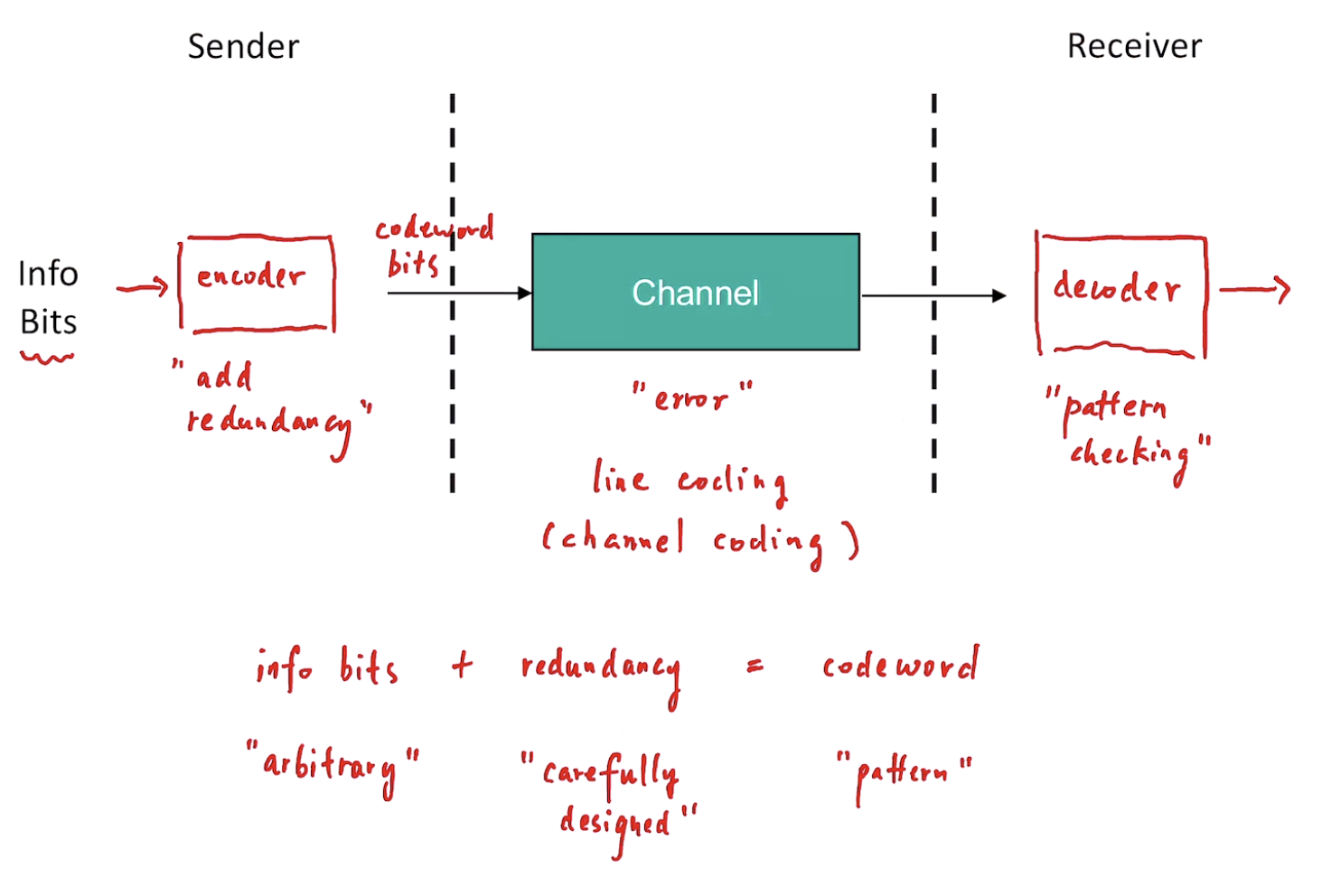
- k : # of info bits
- n - k : # of check/redundancy bits
- n : # of codeword bits (n > k)
Error Vector
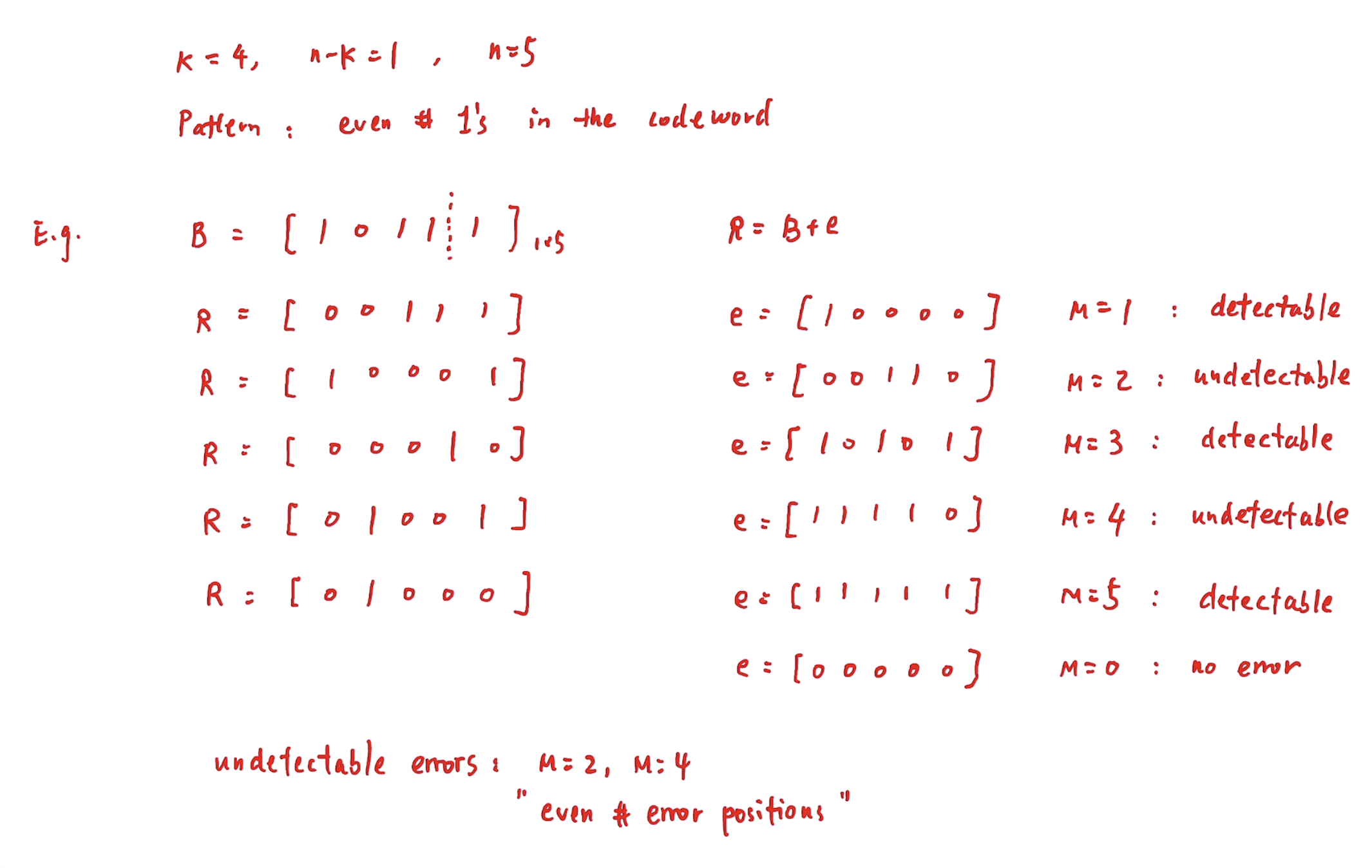
- Suppose we transmit a codeword that has n bits (B = [])
- Define the error vector e = [e(n-1), ... ,e(0)] where
- e(i)=1 if error occurs to the ith bit
- e(i)=0 otherwise
- Received (R) = codeword (B)
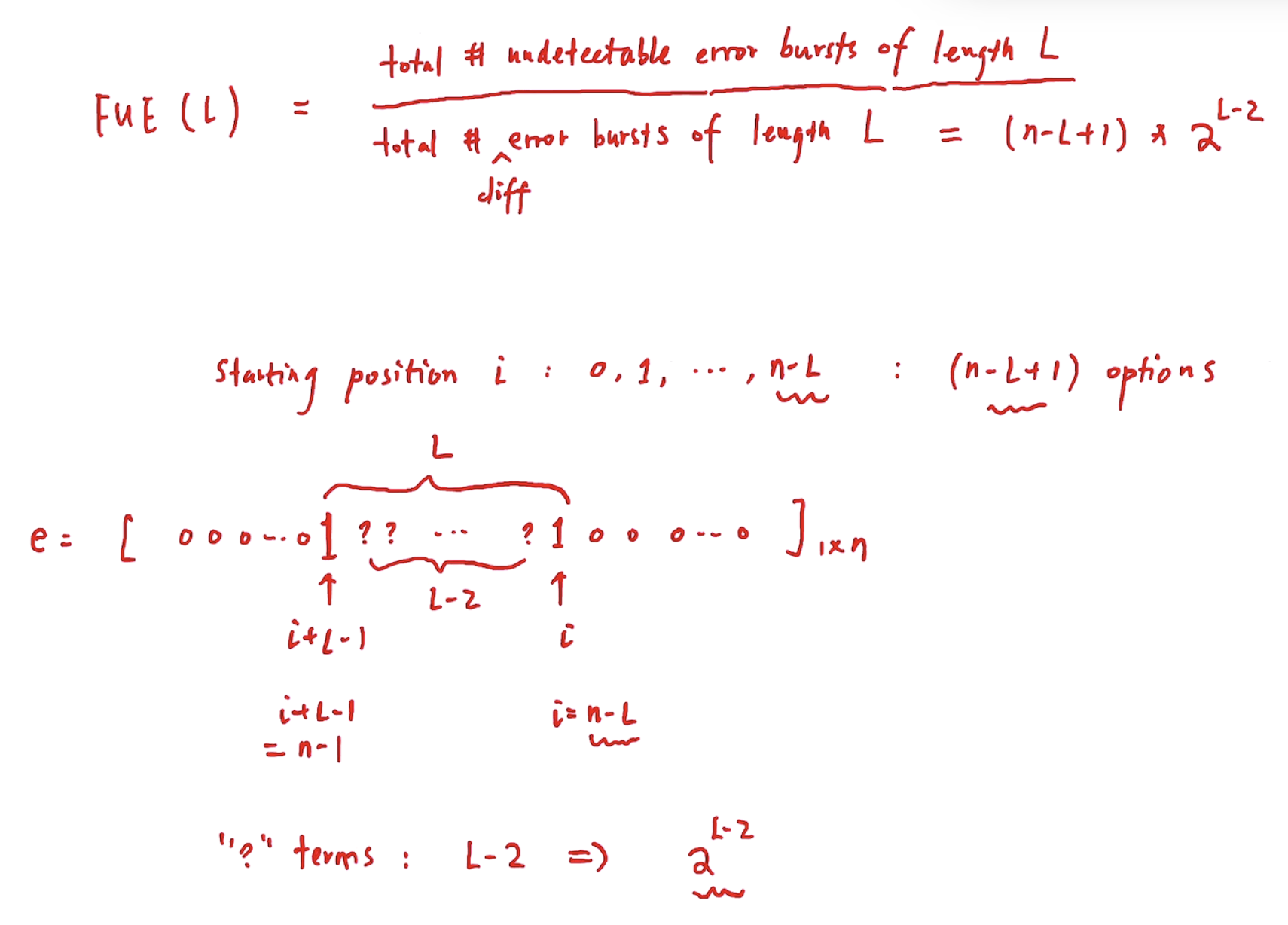
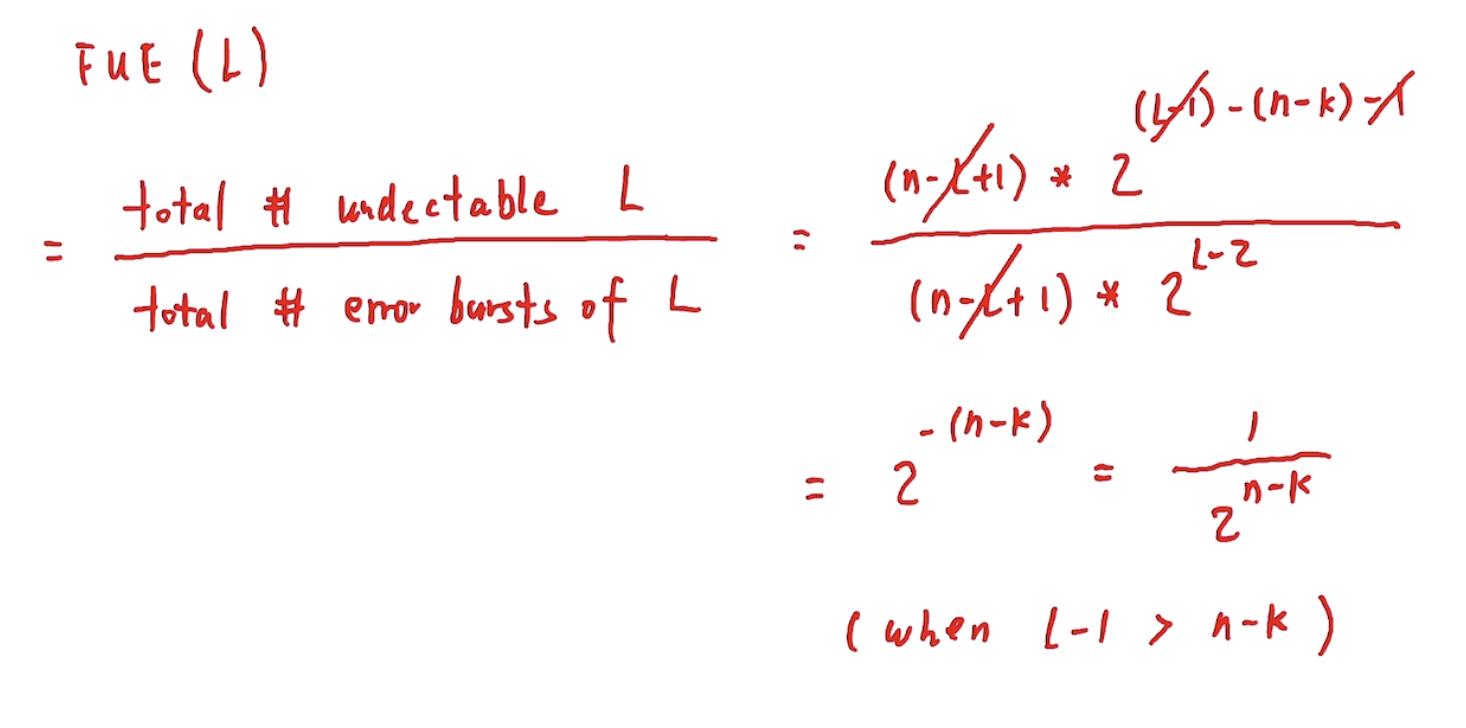
XORerror vector (e) - Fraction of Undetectable Errors (FUE)
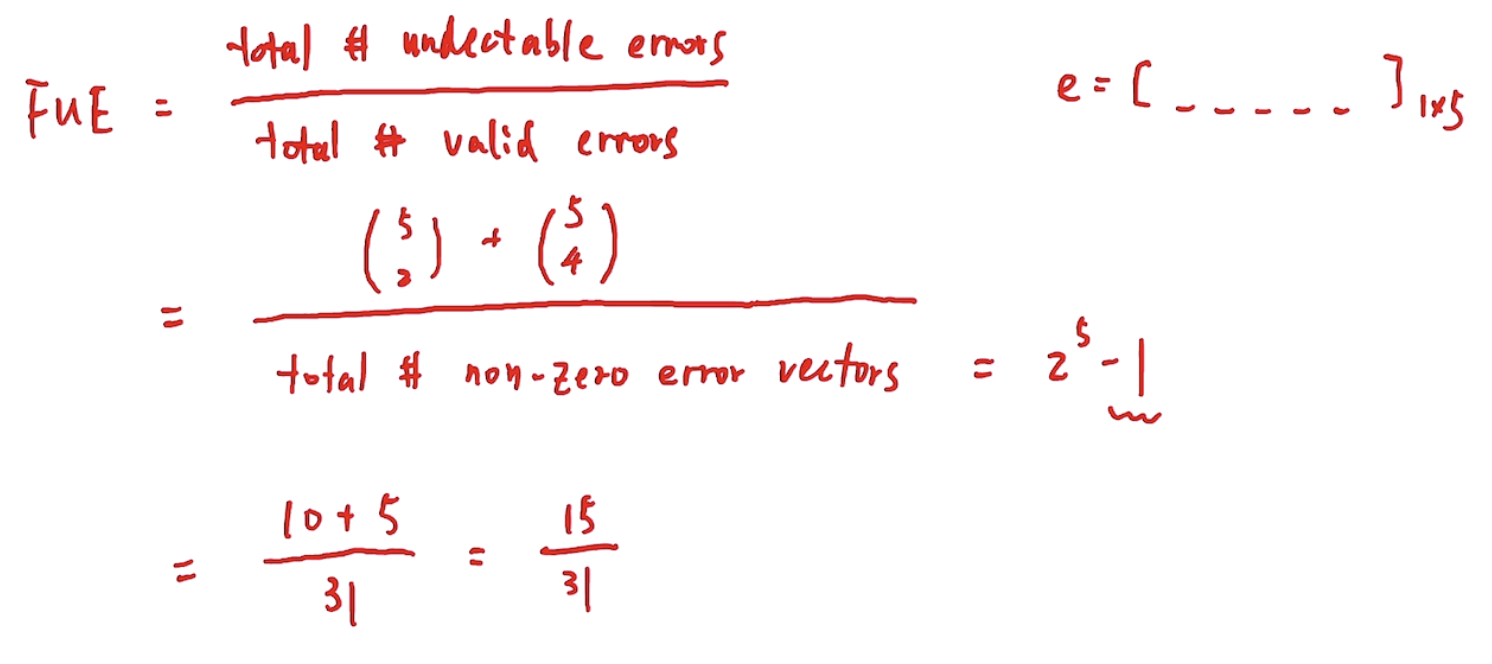
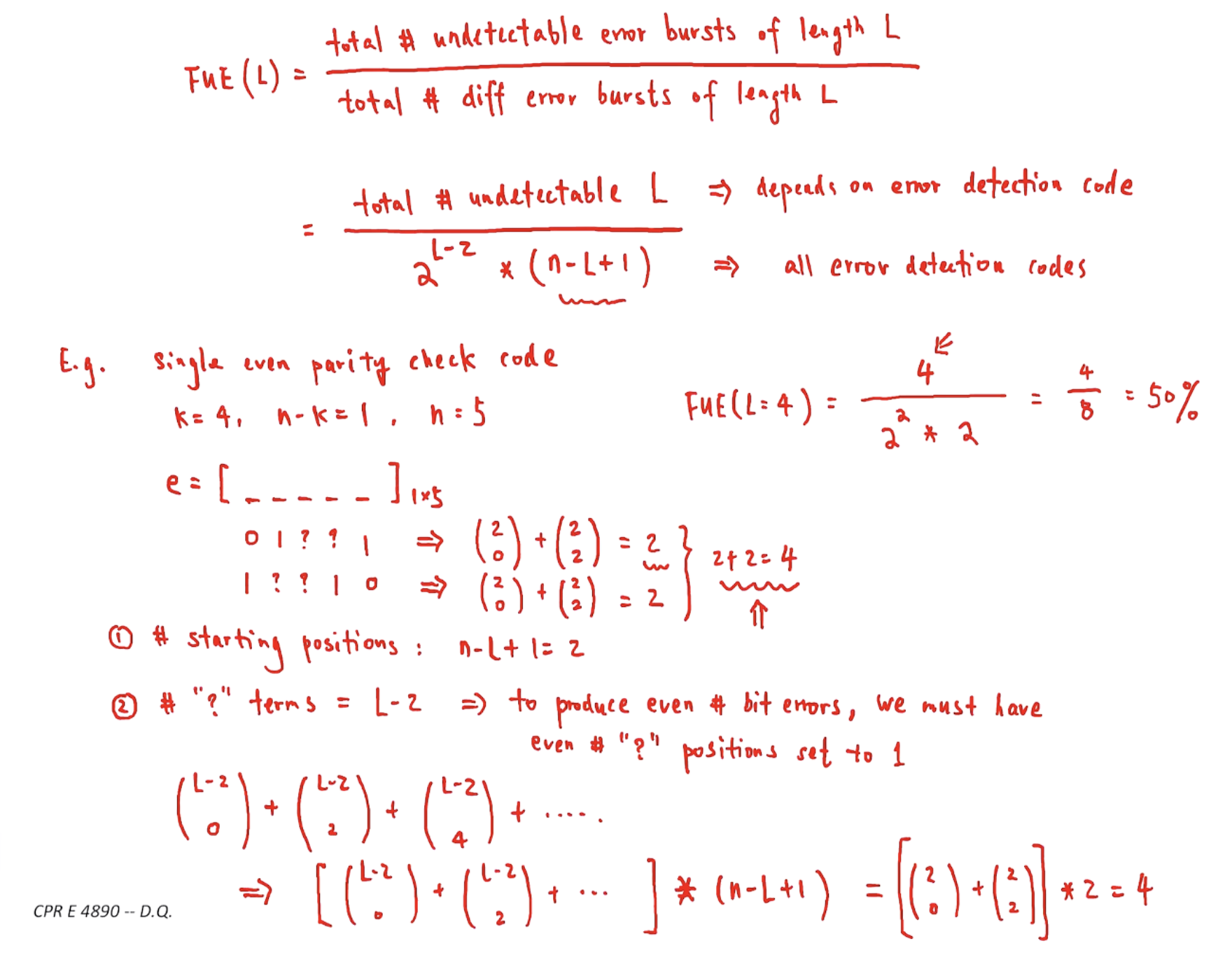
- FUE = total # undetectable errors / total # of valid errors
Any even # bit errors are undetectable. Meaning 2 bit, 4 bit...
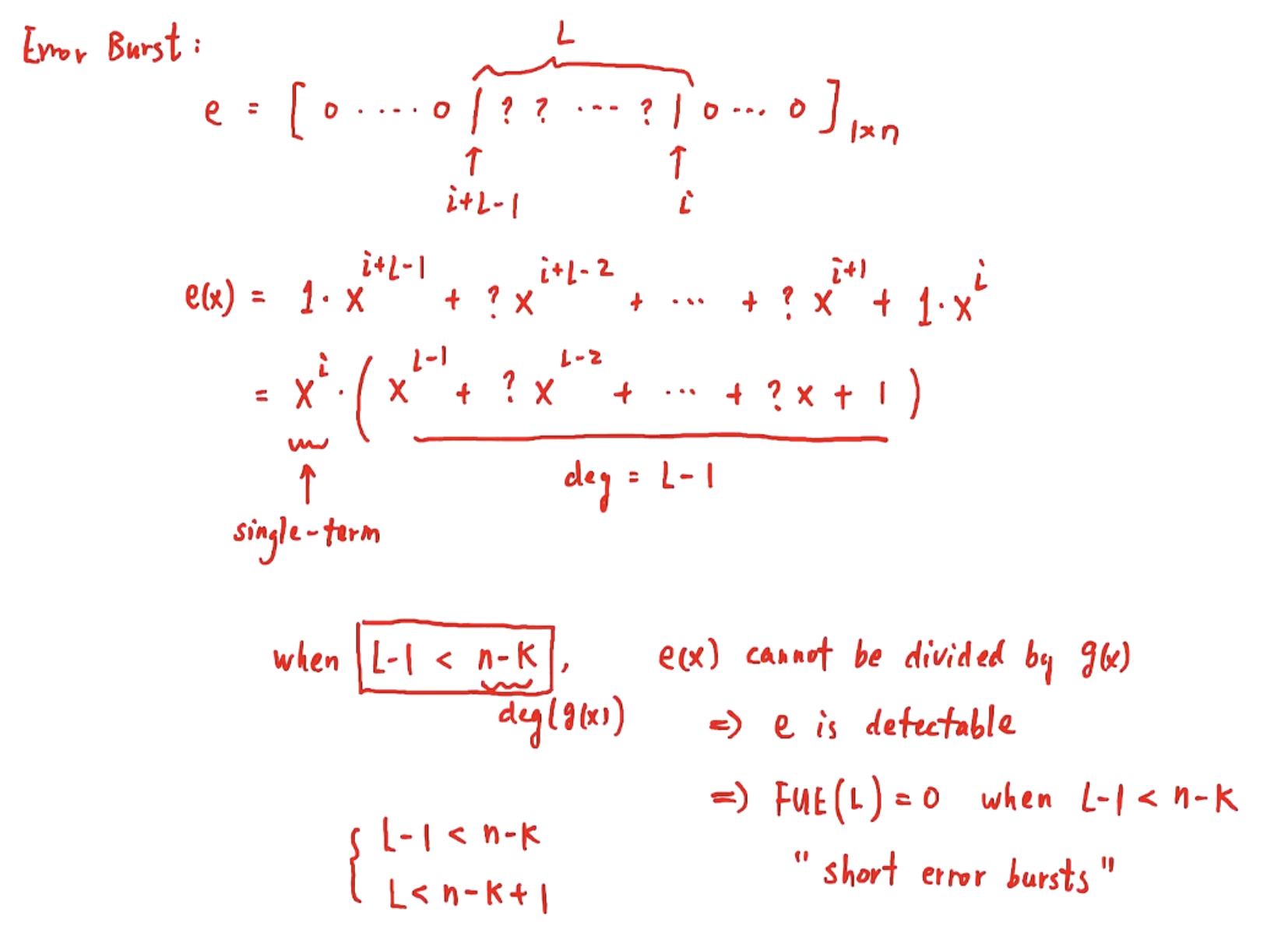
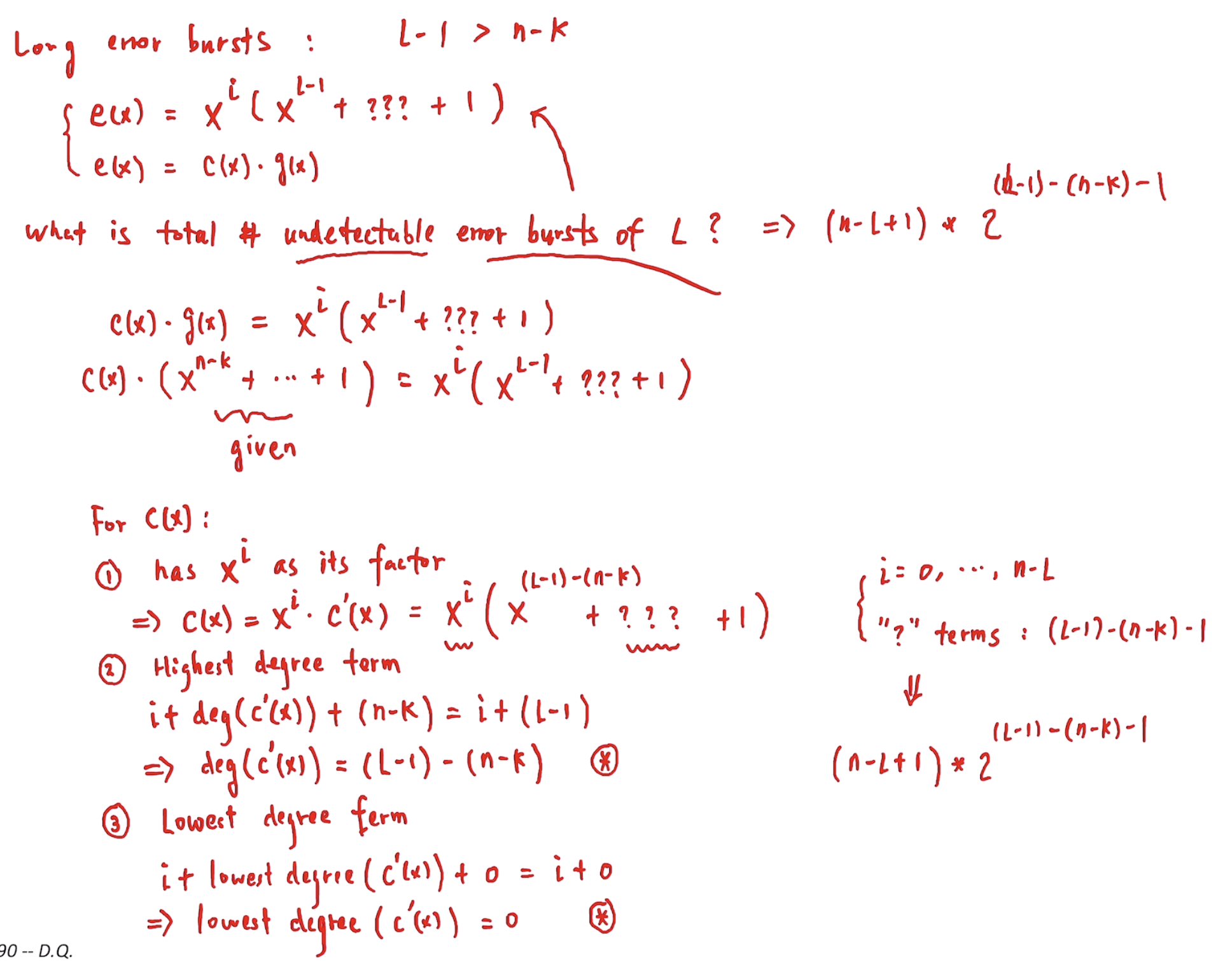
Error Burst
- Errors can be classified according to:
- Number of bit error positions: M-bit error
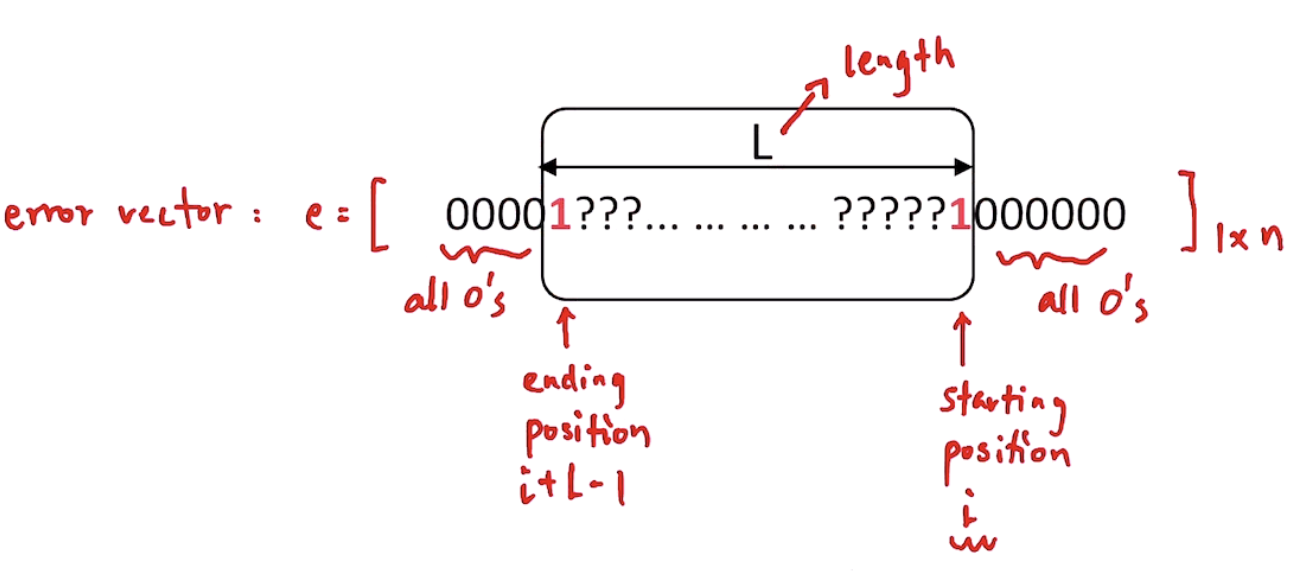
- Separation of bit error positions: error burst of length L
- Error starts at bit position i and ends at bit position (i + L - 1)
Cyclic Redundancy Check (CRC) code
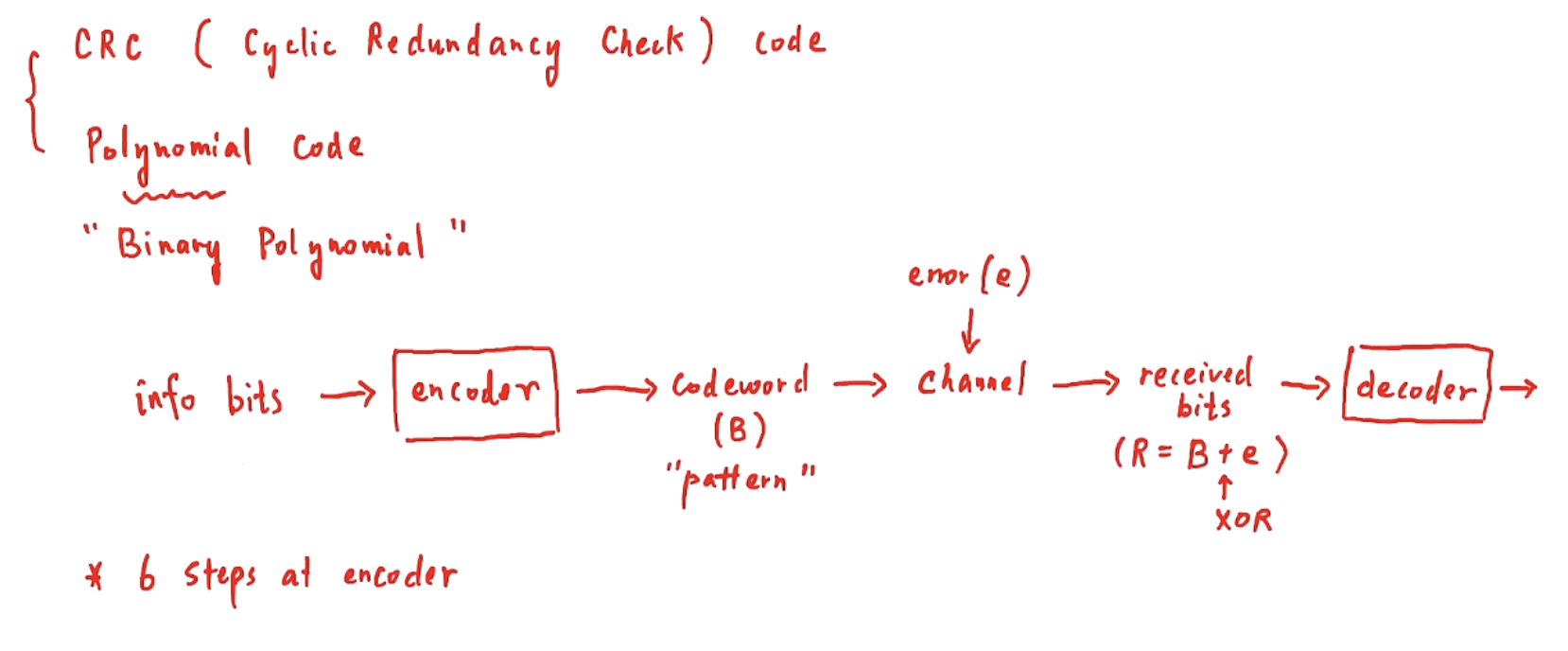
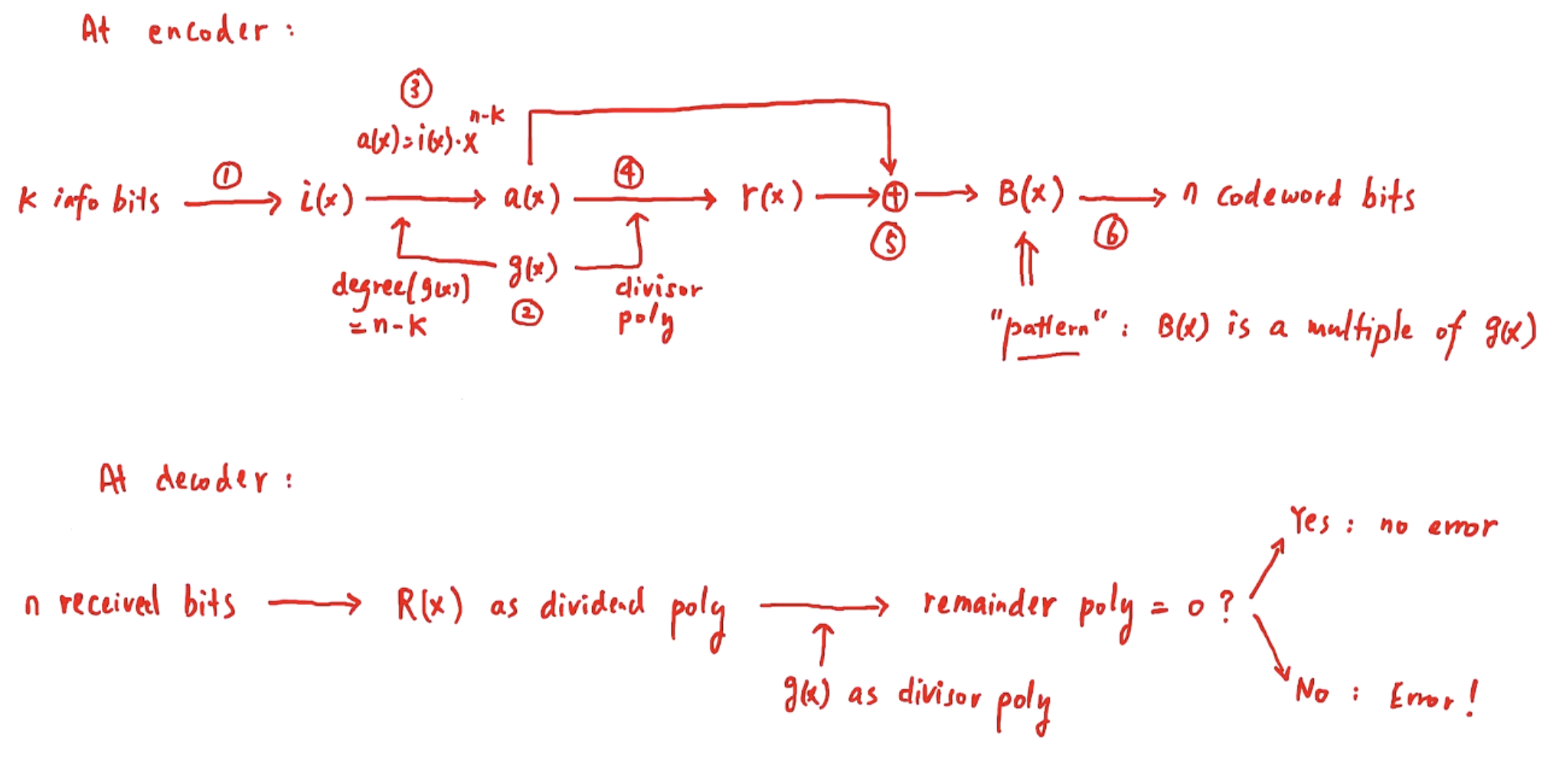
- 6 Step Approach at Encoder:
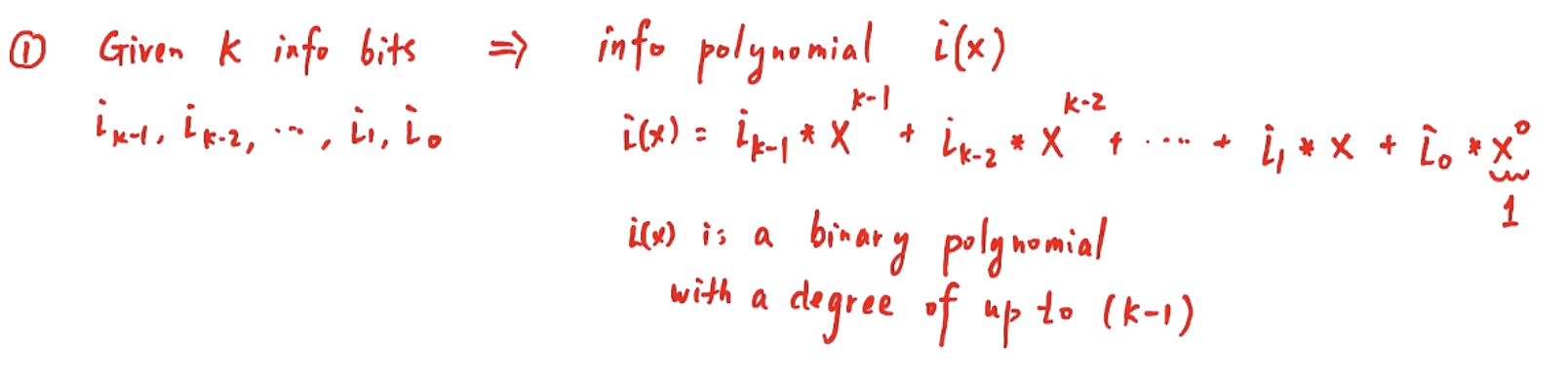
- Given k info bits => Information polynomial i(x)
CRCStep1 - To generate/produce (n - k) check bits
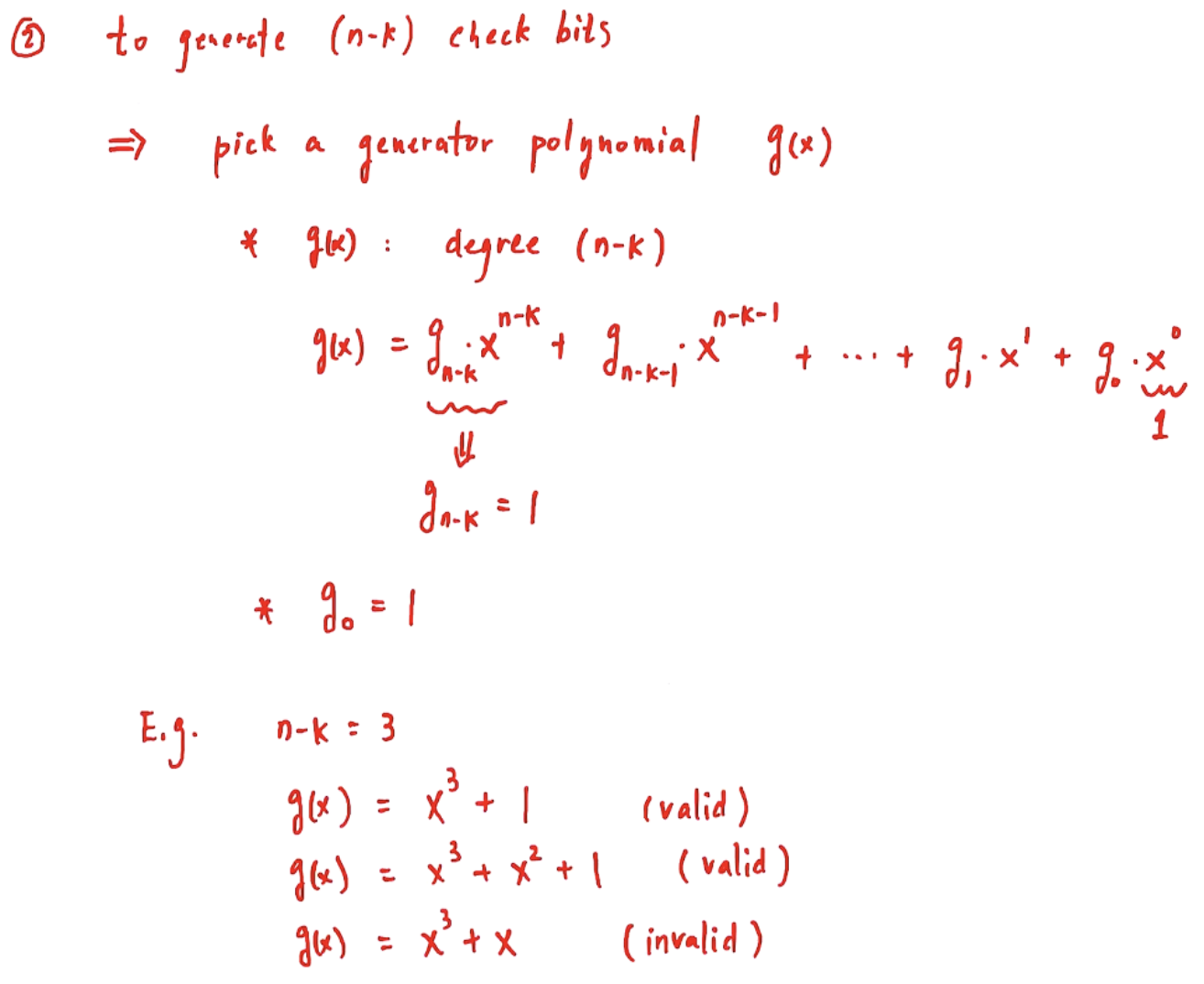
CRCStep2 - Divident Polynomial
- Divisor Polynomial
- Codeword Polynomial
- B(x) coefficients => n codeword bits
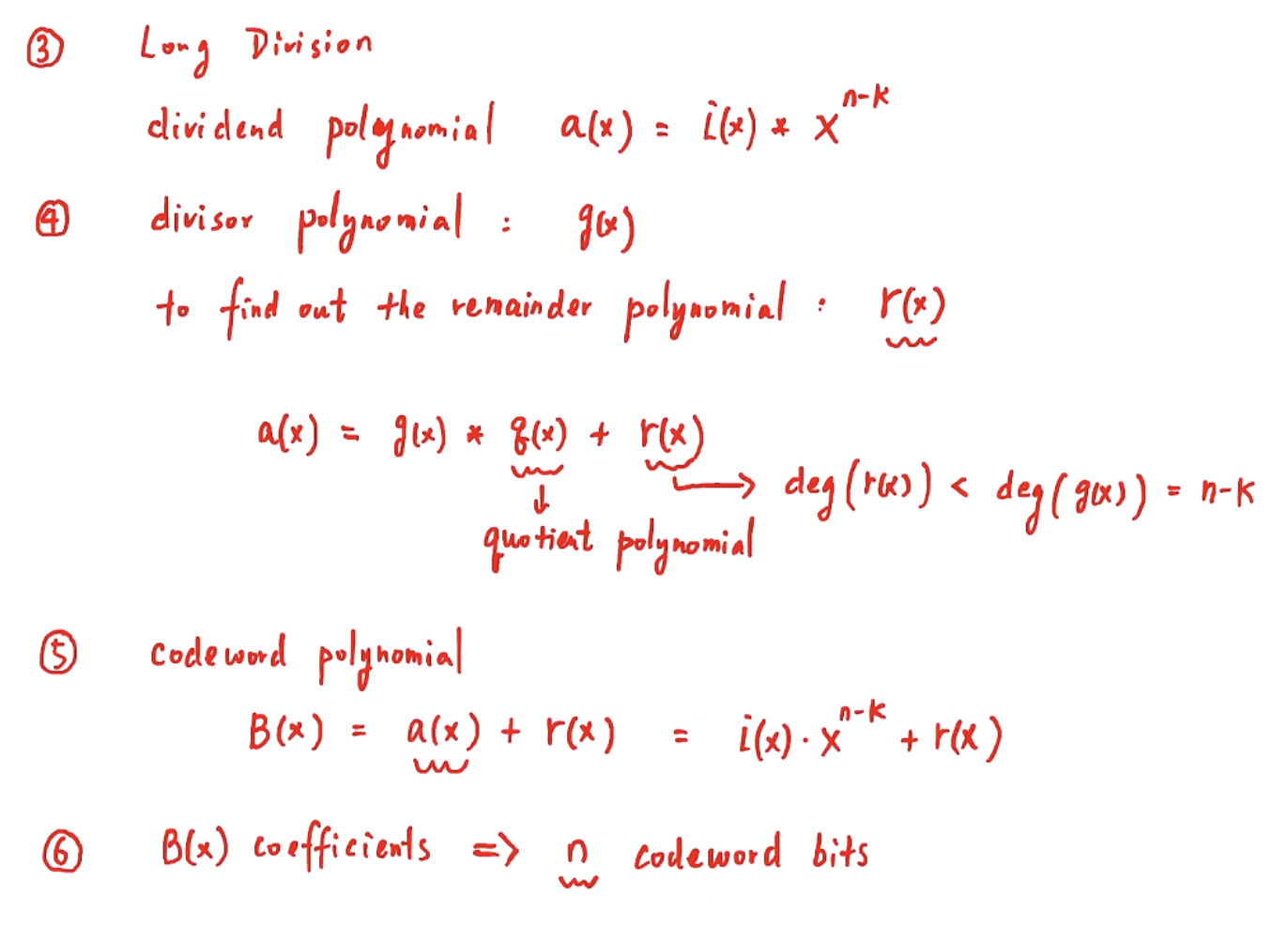
CRCStep3,4,5,6
- Given k info bits => Information polynomial i(x)
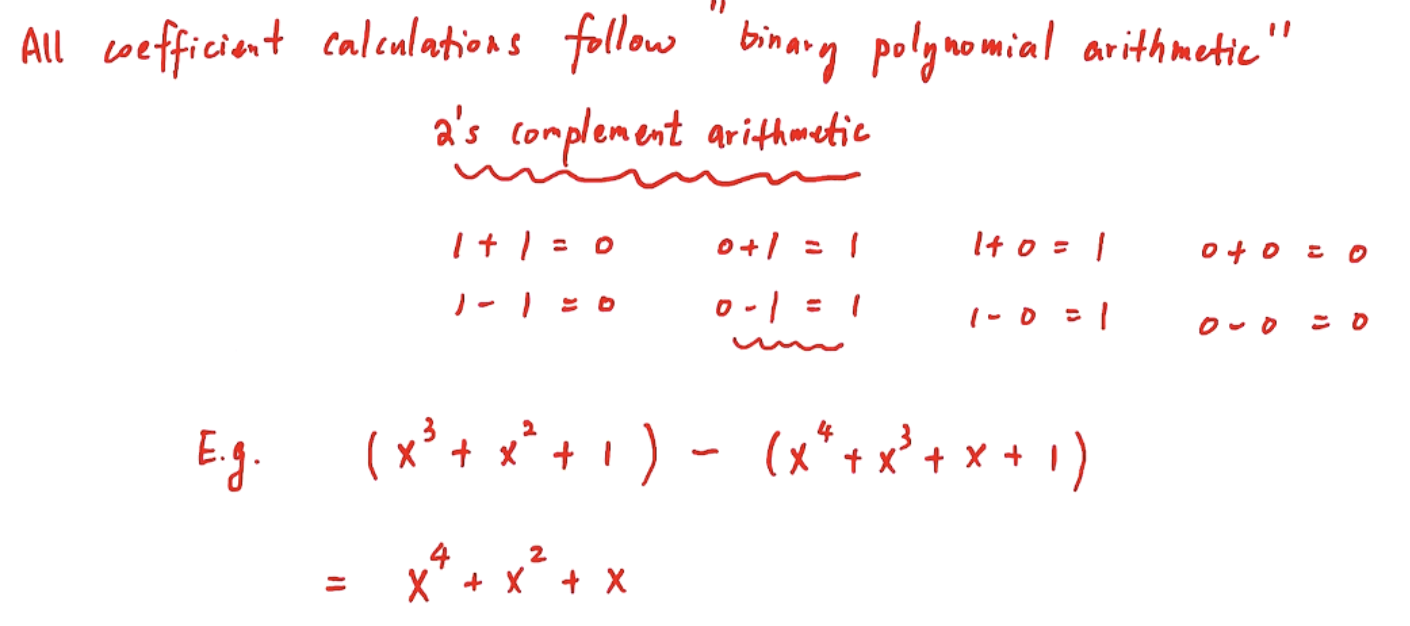
2's complement arithmetic
Example for 6 step approach
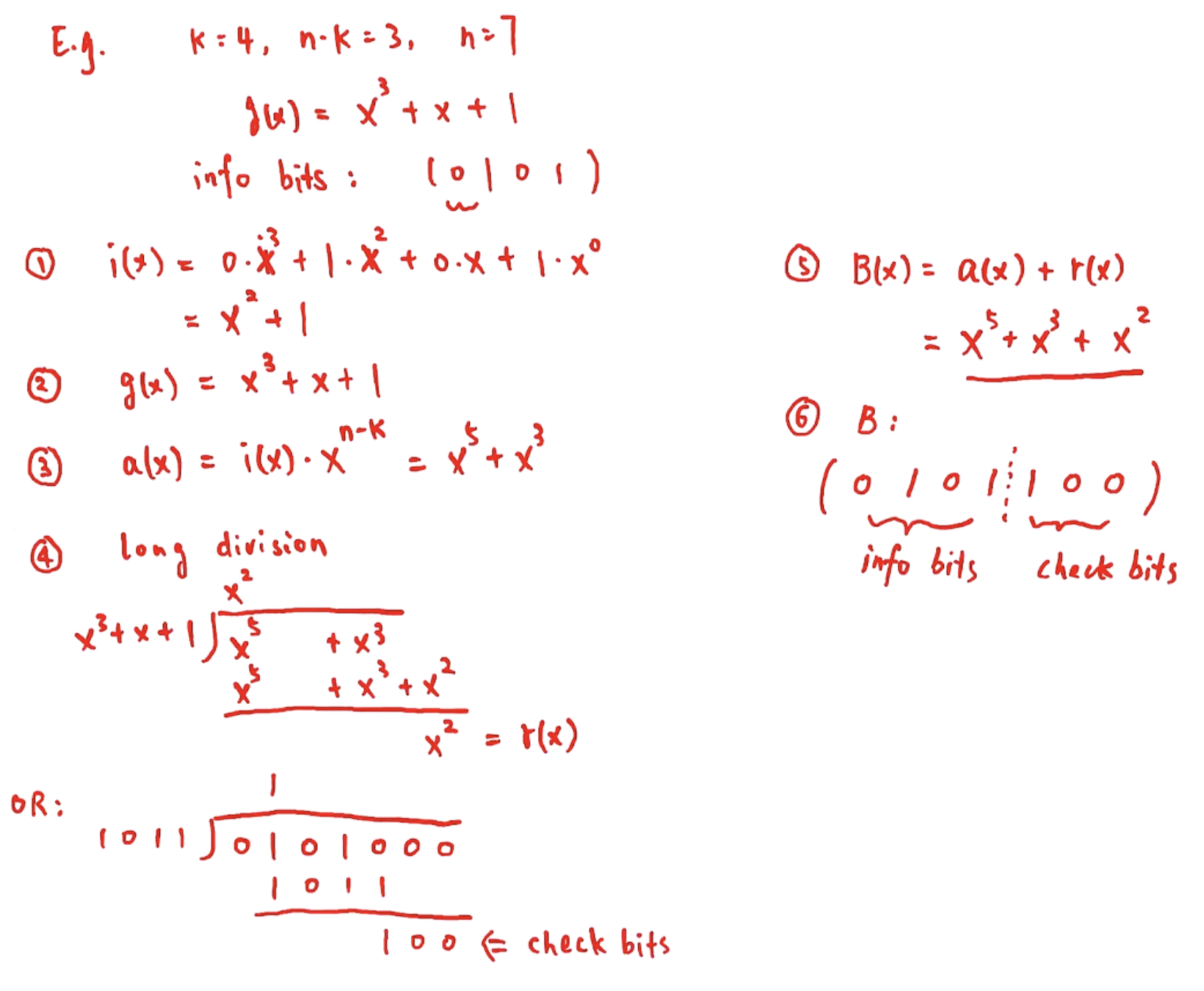
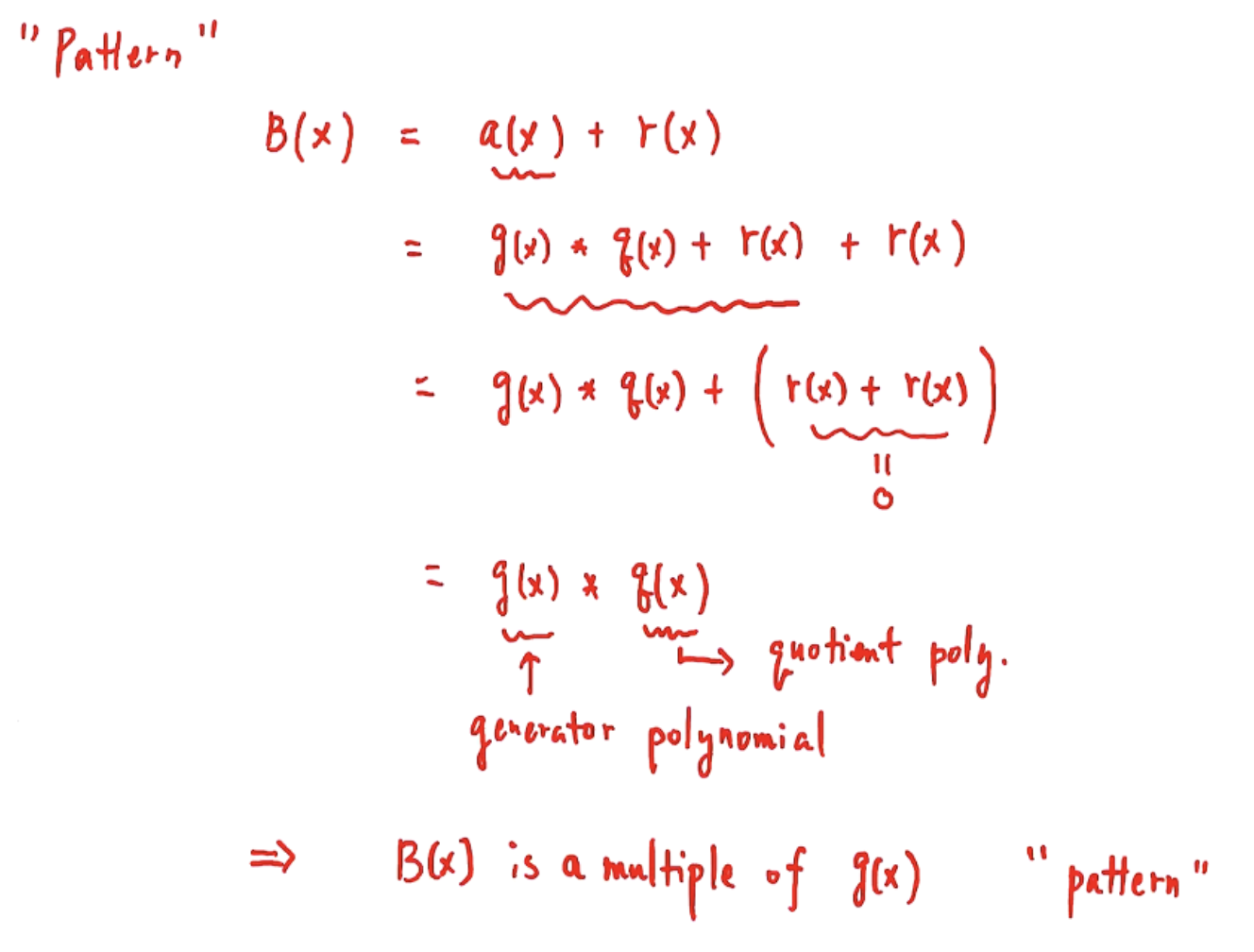
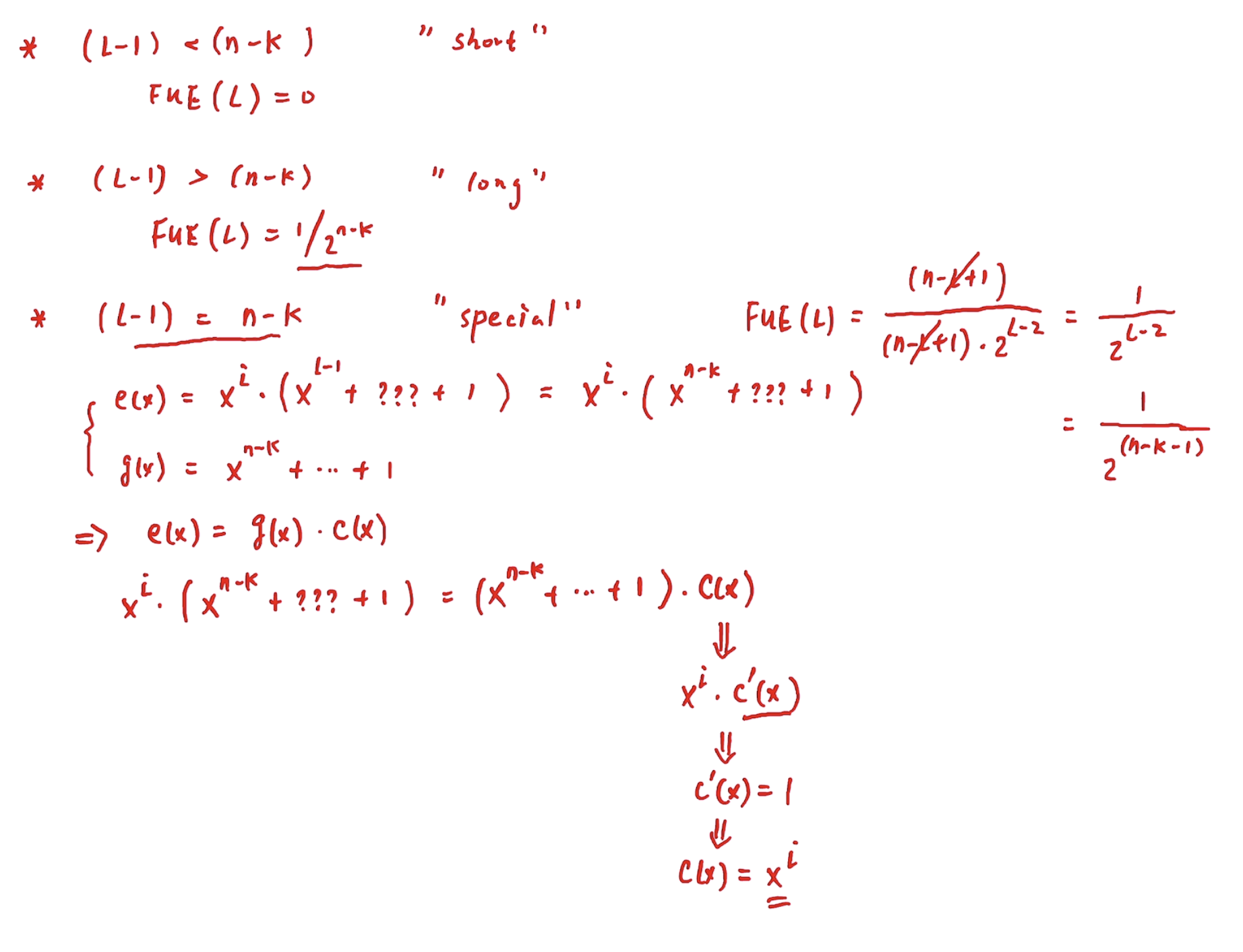
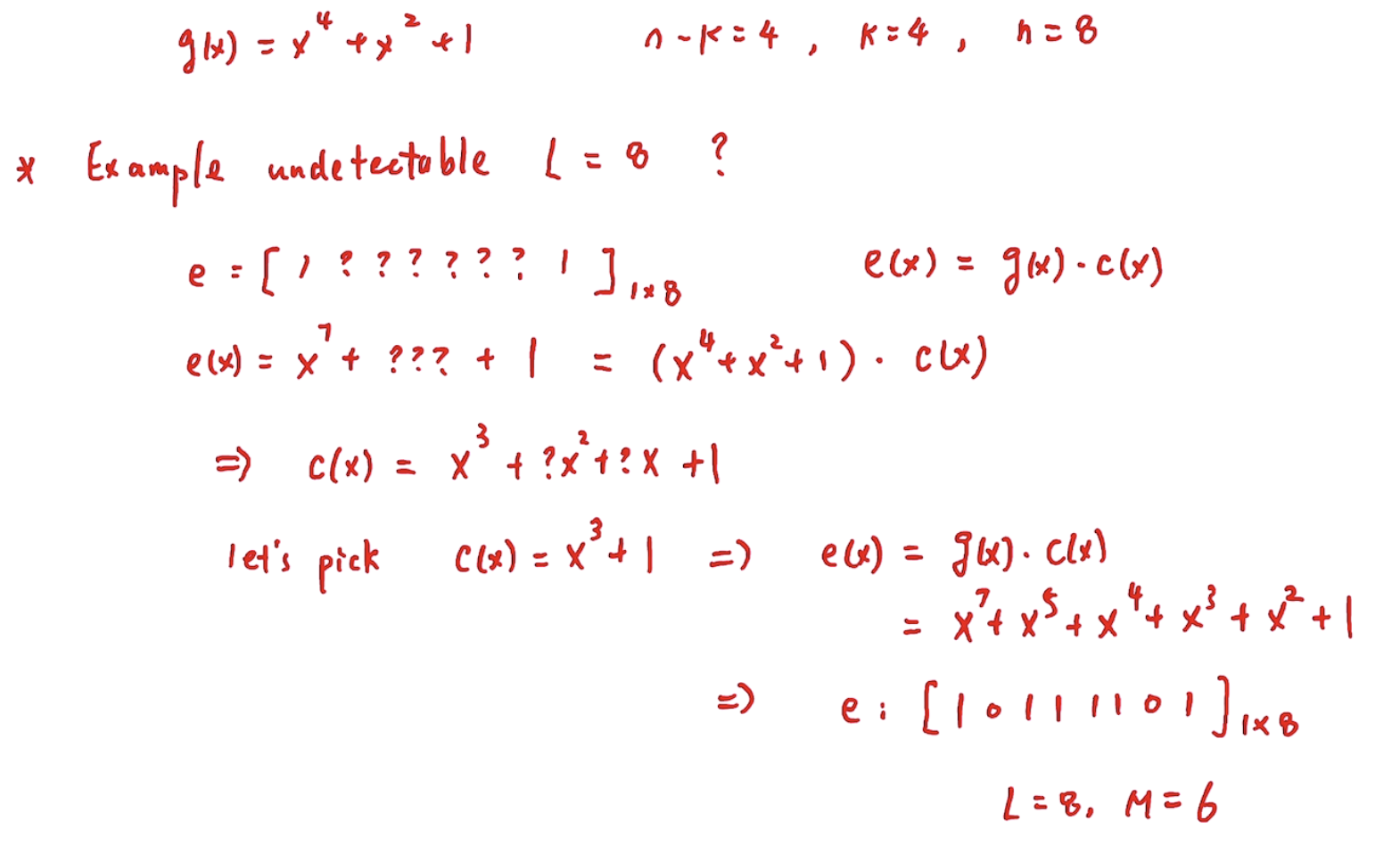
CRC Pattern
Summary of CRC (Combined)
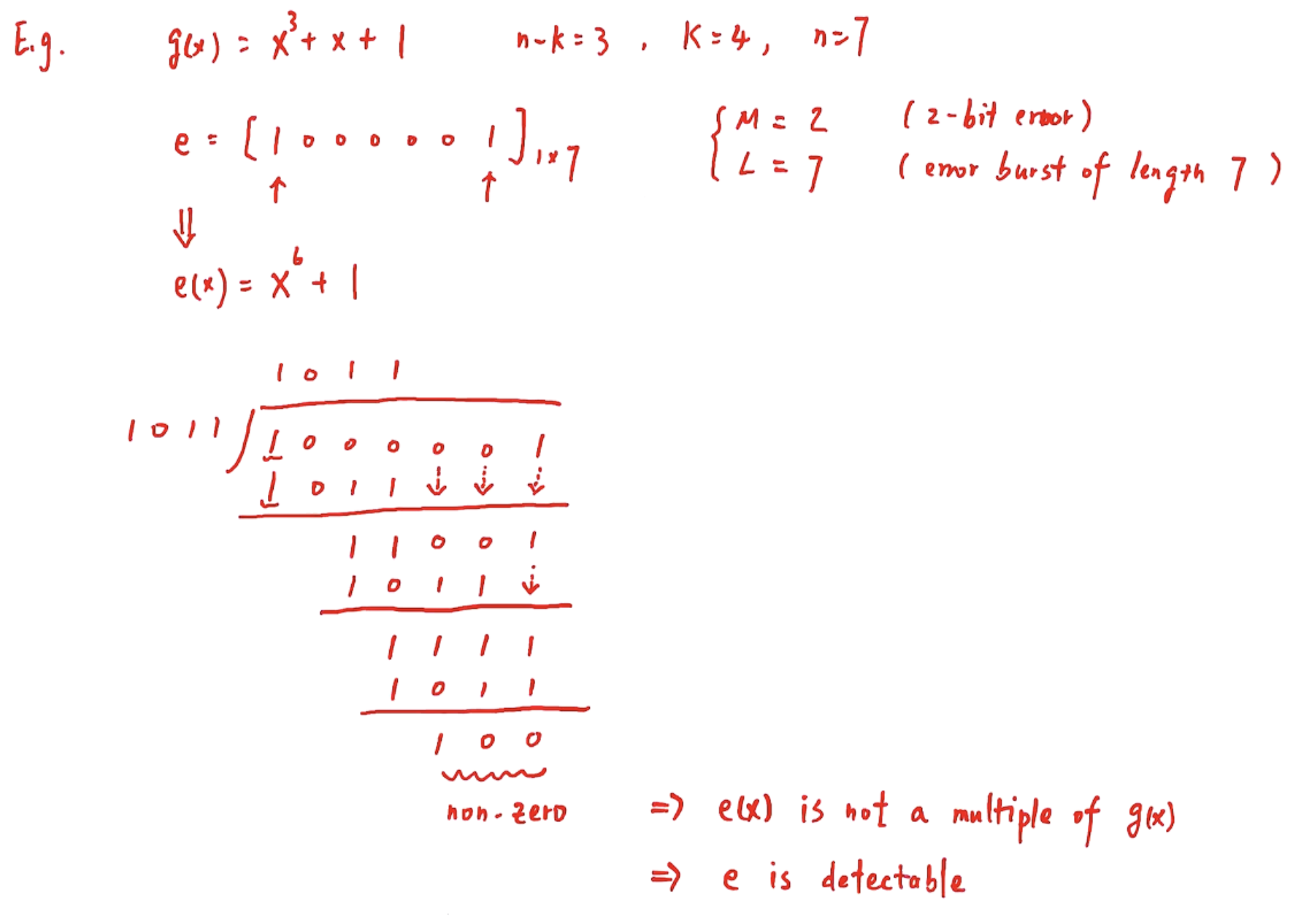
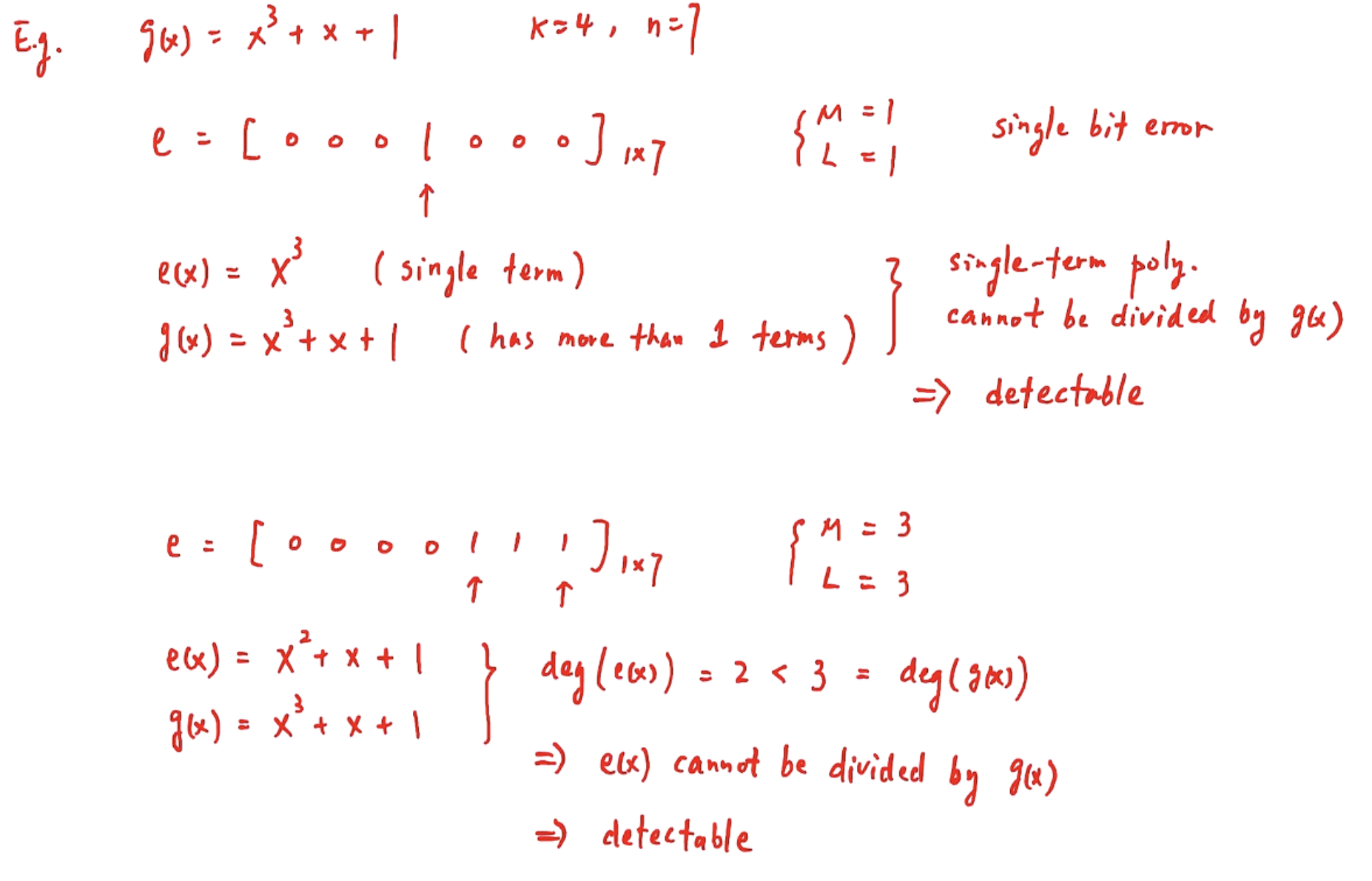
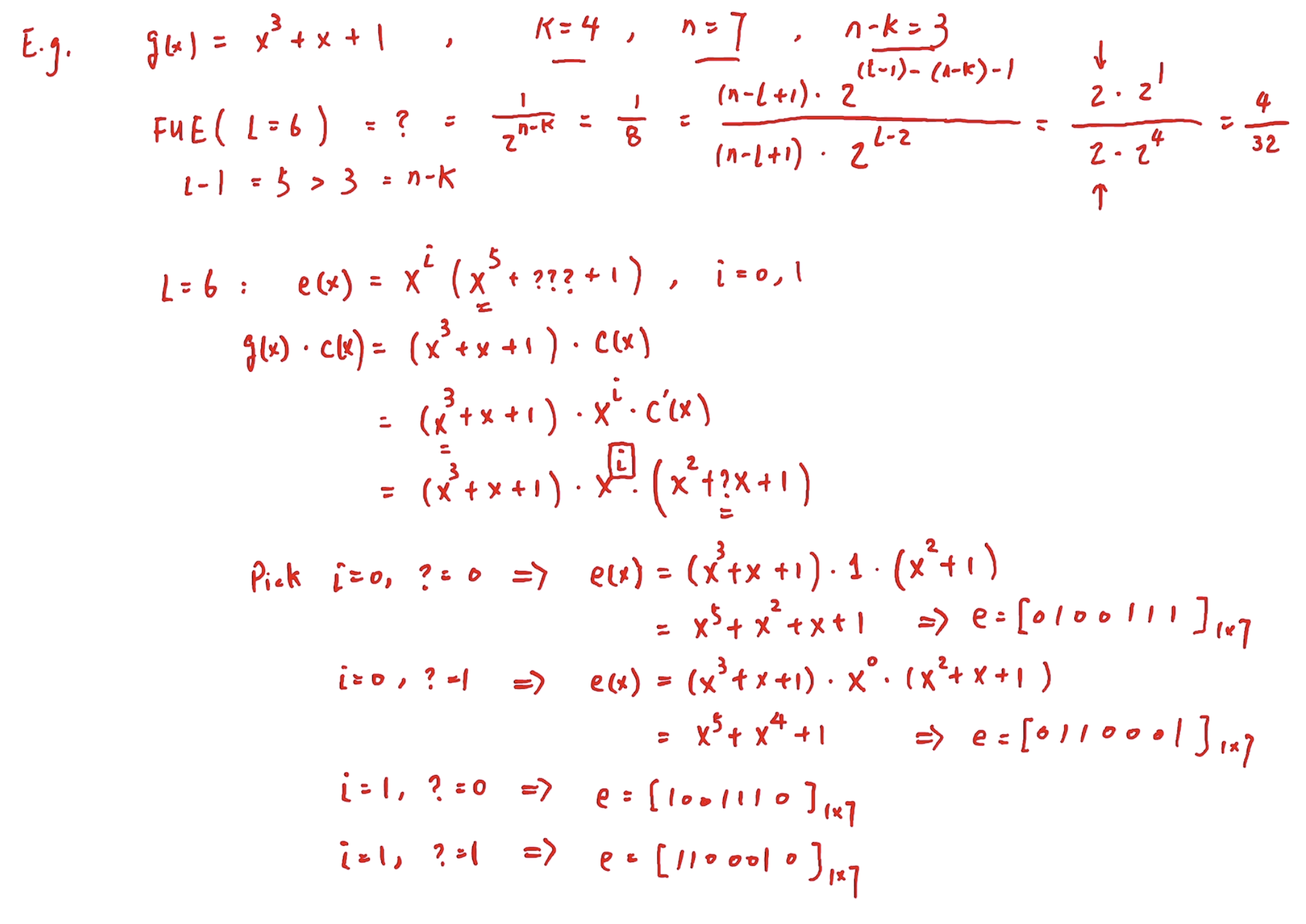
Examples
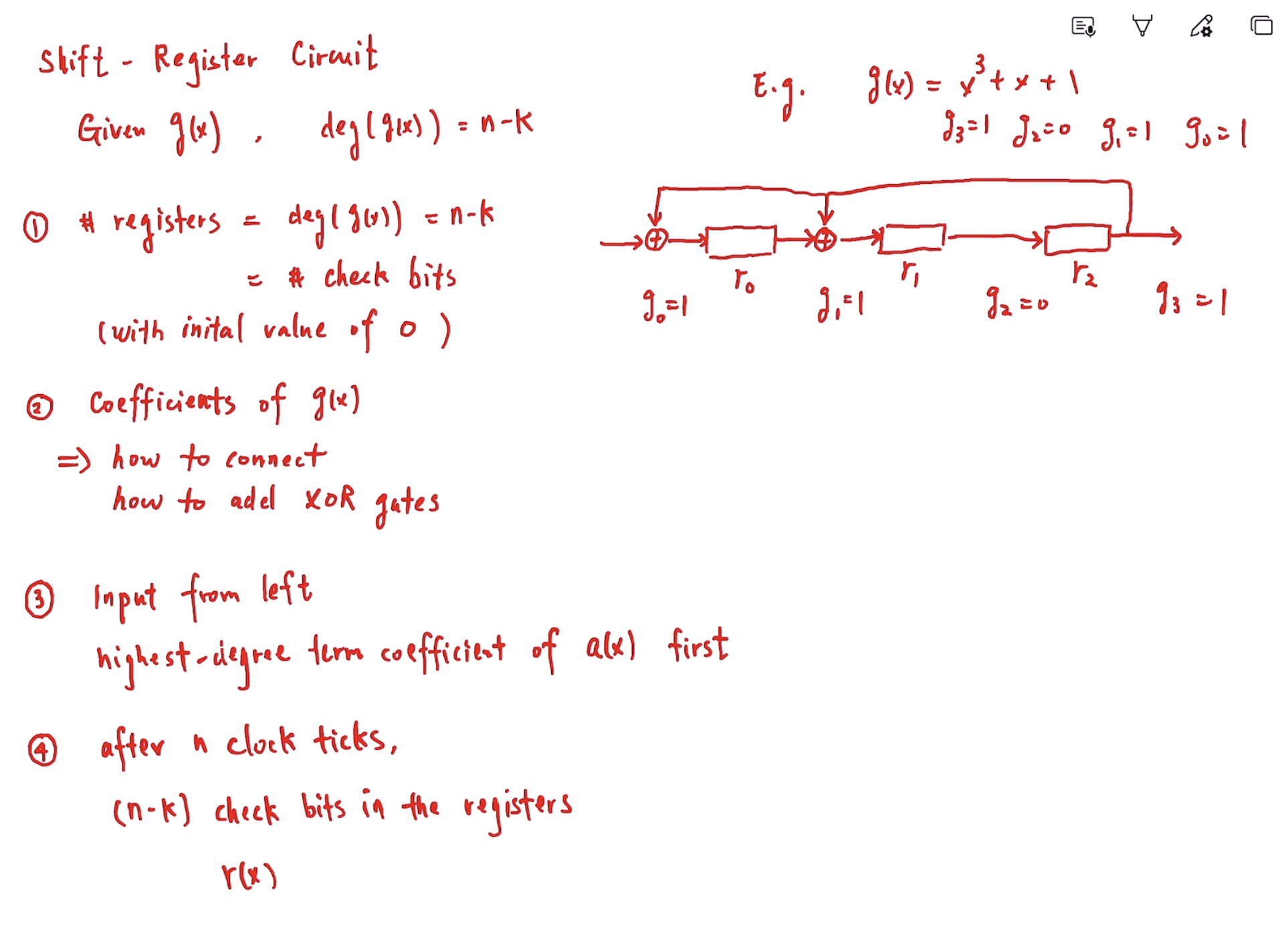
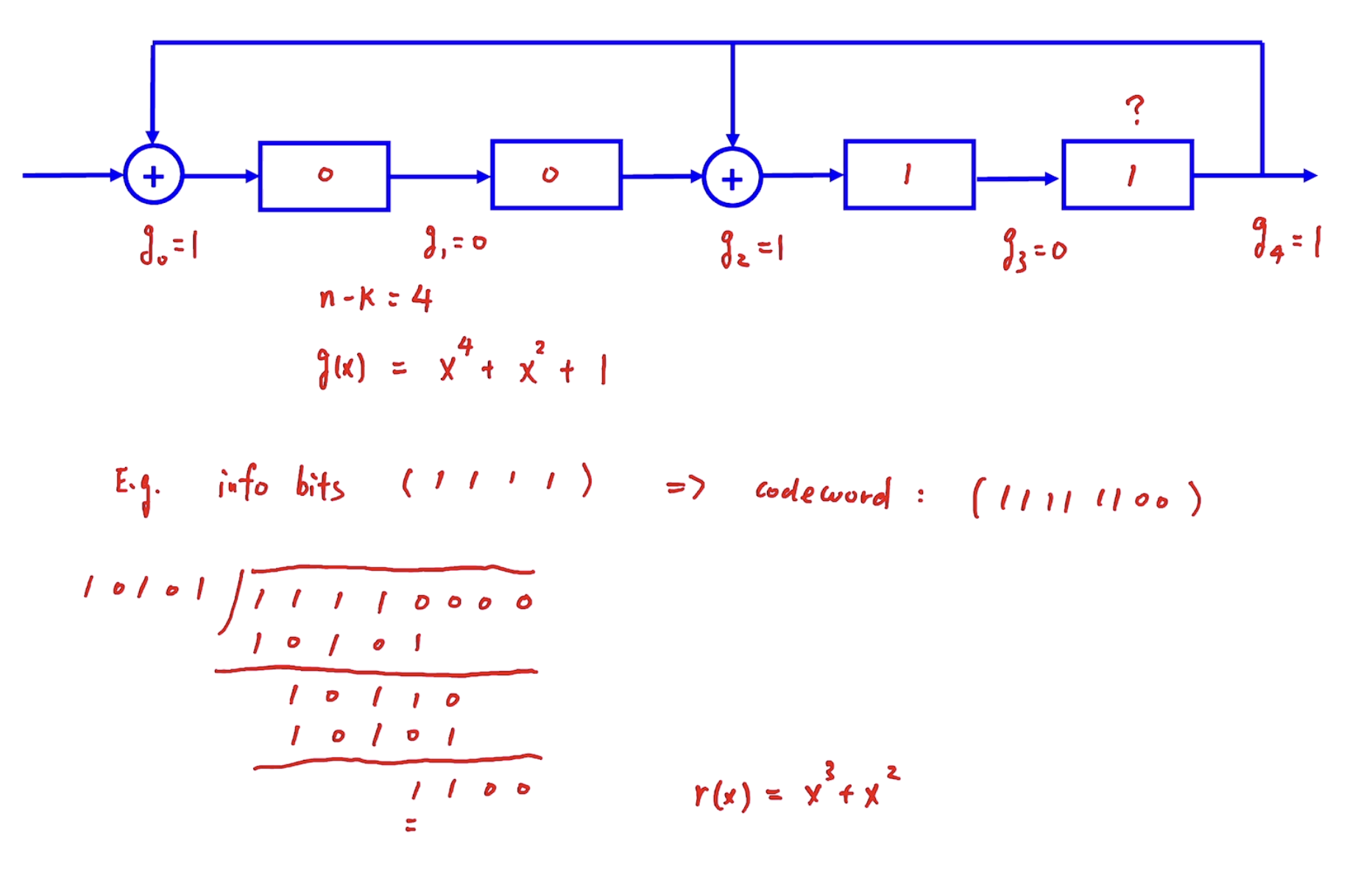
Hardware Implementation of CRC
Error Recovery
ARQ (Automatic Repeat reQuest)
- Three Design Goals of ARQ Protocols
- Goal #1: Ensure each data frame is delivered error-free
- Goal #2: Ensure each data frame is delivered exactly once without duplication
- Goal #3: Ensure data frames are delivered in order
5 Basic Elements
- Error Detection (CRC)
- Control Frames: ACK (required), NAK (optional)
- Retransmission (if needed)
- Timeout
- Sequence Number (SN)
- SN of data frame: position in the sequence
- SN carried in control frames: regarding whether or which data frames in the sequence have been received so far
"cumulative acknowledgement"
- Ex: ACK(20) => all data frames with SN < 20 have been received correctly. => the next data frame that the receiver is waiting for is #20.