Module 3: Cyber-Enabled Adversary
On this page 35
Why Adversaries Use Cyber
Cyber operations offer significant advantages over traditional physical attacks:
- Reach & Accessibility — operations can be conducted remotely, targeting systems anywhere in the world
- Anonymity — attacks are difficult to trace, reducing legal and physical risk
- Cost Efficiency — significant disruption can be achieved with far fewer resources than a physical operation
- Speed — attacks can be executed rapidly, exploiting vulnerabilities before they're patched
- Scalability — the same tools and tactics can target a single individual or an entire nation
- Exploitation of Digital Dependence — modern infrastructure (power, finance, healthcare) is deeply reliant on digital systems, making it highly vulnerable
- Reconnaissance — cyber enables intelligence gathering: scanning for vulnerabilities, researching employees for social engineering, and identifying valuable data
How Adversaries Combine Cyber and Physical
Cyber to Aid a Physical Attack
- Intelligence Gathering: Map security protocols, facility layouts, and schedules
- Disable Security Systems: Take down alarms, cameras, or access controls before intrusion
- Disrupt Communications: Prevent effective response to a physical attack
- Manipulate OT (Operational Technology): Create physical vulnerabilities or distractions in industrial environments
Cyber-Only Attacks
- Data breaches and theft
- Financial theft and fraud
- Ransomware
- Espionage
- Disruption and sabotage
- Establishing persistent long-term access
- Disinformation and manipulation
Physical to Aid a Cyber Attack
- Hardware Interference: Install malware via USB drops or device tampering
- Access to Restricted Areas: Plug directly into a secure network port
- Supply Chain Interception: Intercept and modify hardware in transit to implant backdoors or surveillance tools
Additional Considerations
- Hybrid Attacks: Coordinated simultaneous use of physical and cyber methods
- Social Engineering: Used in both domains to manipulate people
- Supply Chain Attacks: Compromise a supplier or third party to reach the primary target
The Cyber Adversary
Levels of Expertise
- Script Kiddies — use existing tools with little technical knowledge
- Amateur — some skill, often opportunistic
- Professional — skilled, targeted, well-resourced
Methods
- Remote access
- Social engineering
- Physical access
Organizational Structure
- Individual actor
- Cause-based group
- Loose collective (e.g., hacktivist groups)
- Criminal enterprise (organized as a business)
- State-based: state-supported, state-sponsored, or state-run
Adversary Goals
Goals are often interrelated and frequently tied to financial gain.
Money
Achieved through: theft (account access, redirecting funds, purchasing fraud), ransomware, and extortion.
Data
- Types: PII, medical records, IP, operational/infrastructure plans
- Threats: Disclosure, reuse (identity theft, account access), or as a stepping stone to a larger attack
- Data can also be held hostage for ransom
Disruption
- Physical services: Power grids, water, traffic, gas, building controls, medical devices
- IT services: 911 systems, government services, communications
- Disruption can be used as leverage (ransom) or as an end goal (terror/chaos)
Influence
- Personal attacks: Swatting, fake kidnapping claims, direct threats — often demanding money
- Public attacks: Sole purpose is to cause fear and chaos, not necessarily financial gain
Public Trust
- Eroding trust in governments, elected officials, public services, elections, or corporate brands
How Attacks Are Executed
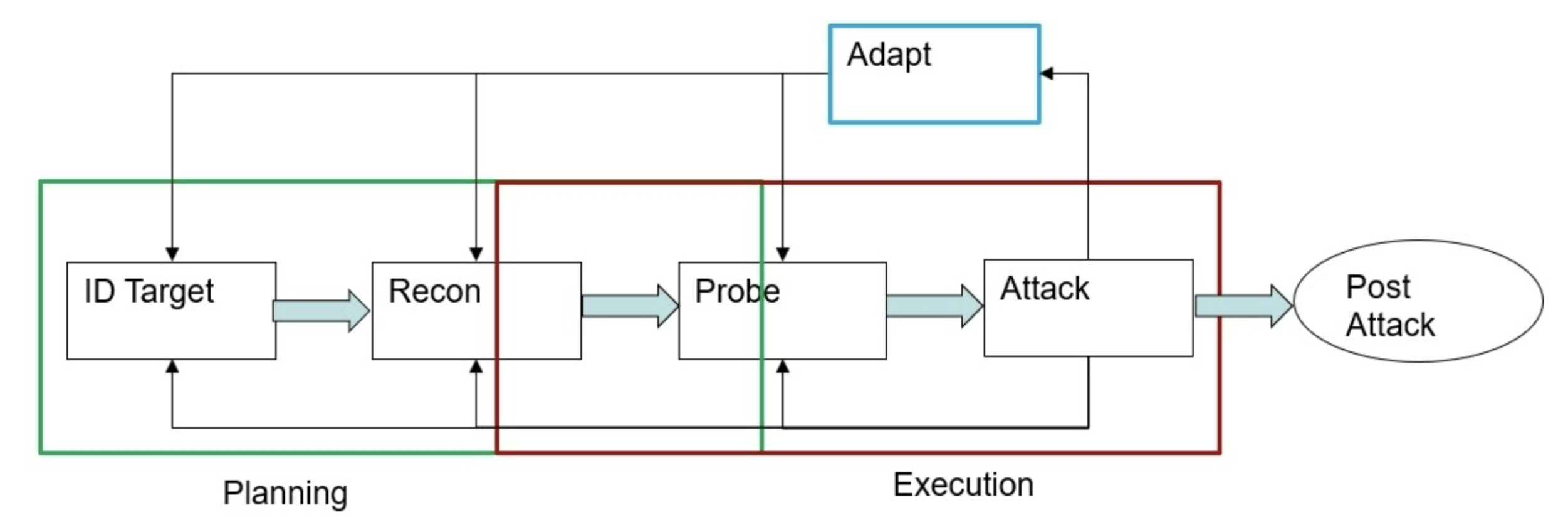
Attacks of Opportunity
- Typically carried out by script kiddies
- Target systems that are unpatched or misconfigured (initial or reconfiguration errors)
- May use general social engineering techniques
Advanced Persistent Threat (APT)
- Attackers select specific targets and wait patiently for a mistake — a misconfiguration or missed patch
- Alternatively, they target employees via phishing: credential theft, drive-by malware downloads, or malicious attachments
- Likely APT Targets: IoT infrastructure (water, power, transport), financial institutions, organizations with valuable intellectual property (agriculture, manufacturing, technology)
What Attackers Target
Vulnerable Systems
- Bad access controls
- Misconfigured systems (initial setup errors, reconfiguration errors)
- Unpatched or legacy systems
- Zero-day vulnerabilities
Three Categories of Target Systems
| System Type | Description | Example Attack |
|---|---|---|
| Data Systems | Store critical data (IP, PII, credit cards) | Ransomware: encrypt and steal, threaten to release |
| Process Systems | Run essential operations (billing, inventory, medical) | Ransomware: shut down operations to demand payment |
| Control Systems | Manage physical assets (pipelines, power grids, traffic) | Manipulate sensor data or settings to cause physical damage |
Vulnerable People
Over 50% of data loss stems from social engineering. Attack vectors include:
- Phishing and spear phishing emails
- Malicious email attachments
- Drive-by or directed malicious websites
- Poor access control policies
Insiders
It is often easier to exploit a person on the inside — intentionally (recruited/coerced), accidentally (untrained), or "intentionally accidental" (social engineering tricks users into acting as unwitting accomplices).
Vulnerable Processes
- Internal: Attackers gather knowledge of internal workflows to use them against the organization
- External: Supply chain and partner security are common weak points
Real-World Examples
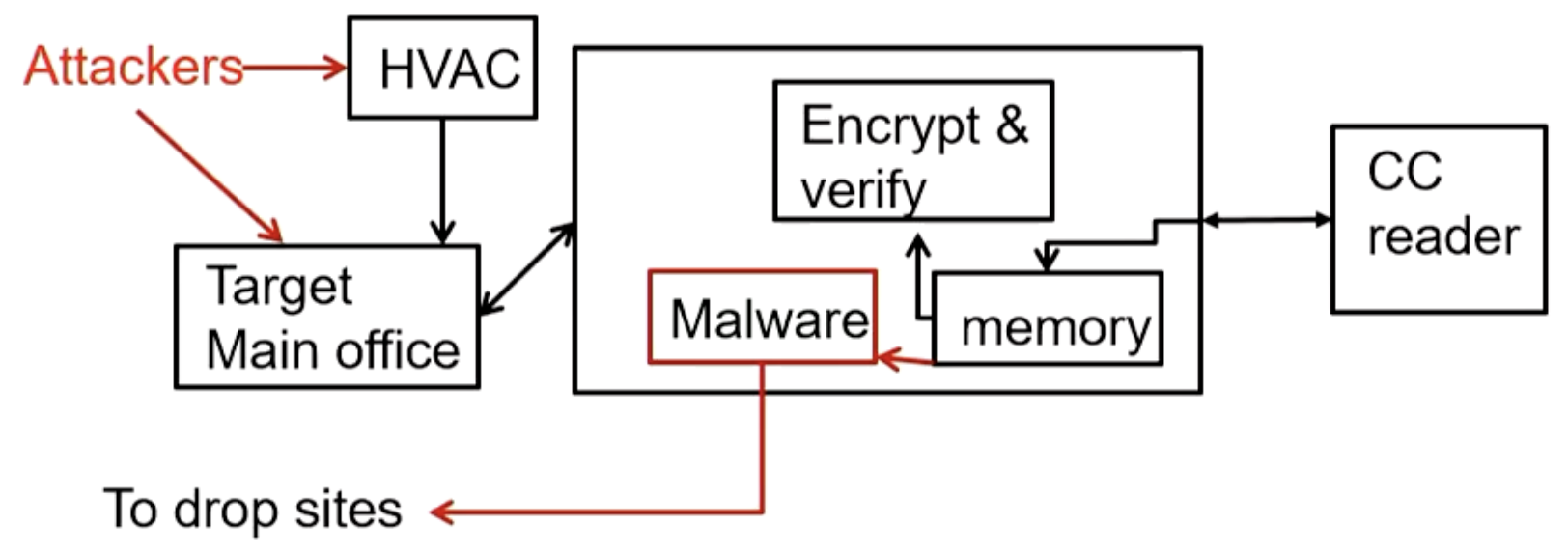
Target (Retail Breach)
- Attackers gained credentials via a compromised HVAC contractor
- Installed memory-scraping malware on POS terminals (tested Nov 15–28, deployed Nov 30)
- Stole millions of credit card numbers
Sony
- Believed to be an APT; exact entry point unclear
- One of the first attacks to cause widespread destruction of computing resources
- Well-written, highly complex malware; involved data theft and operational disruption
Colonial Pipeline
- Ransomware attack affecting business processes and fuel distribution across the U.S. East Coast
Florida Water Plant
- Attacker gained remote access and attempted to raise sodium hydroxide (lye) levels to dangerous concentrations
Ukraine Power Grid
- Russian-attributed cyberattack that caused widespread power outages
Iranian Centrifuges (Stuxnet)
- Malware manipulated sensor data to cause physical damage while reporting normal readings — also exploited process vulnerabilities
Turkish Pipeline (2008)
- One of the earliest known cyber-physical attacks
- Gained access via internet-connected cameras, changed pipeline pressure settings, and disabled monitoring systems
2016 DNC Email Leak
- Spear phishing used to gain access; leaked emails influenced public opinion during a presidential election
2020 Twitter Bitcoin Scam
- Insiders were social-engineered into granting access to high-profile accounts to run a cryptocurrency scam