Physical Layer
On this page 30
Digital Transmission in Computer Networks
Purpose
Transfer a sequence of binary data (0s and 1s) from a transmitter to a receiver.
Method
Binary information is transmitted over a physical medium using pulses and sinusoids, subject to:
- Predefined signal formats
- Discrete symbols
- Finite symbol set
- Finite number of signal formats (pulses)
Bit Rate
Definition
Bit rate is the rate at which binary data is transmitted, measured in bits per second (bps).
Formula
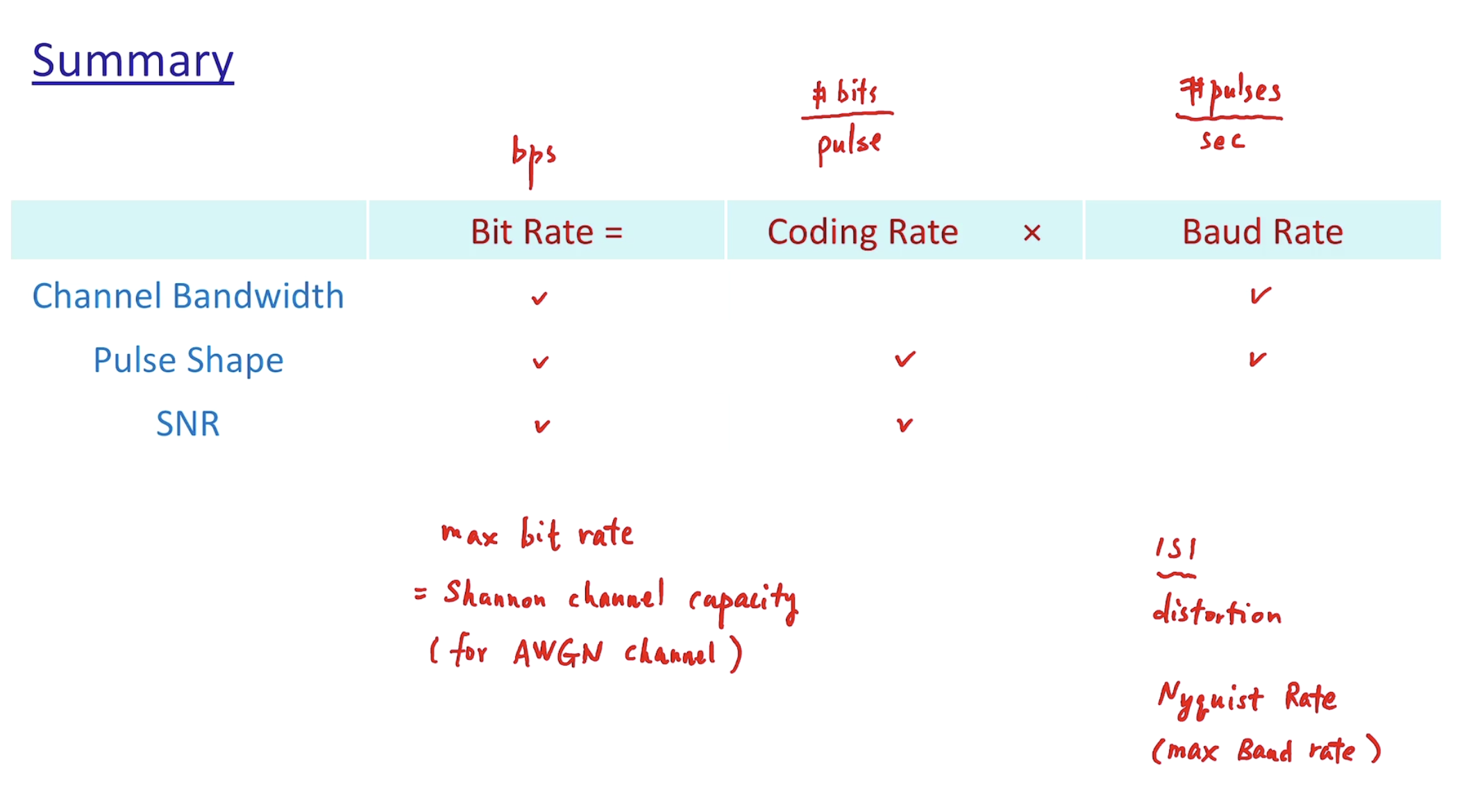
Bit Rate (bps) = Coding Rate (bits/pulse) × Baud Rate (pulses/second)
Key Definitions
Coding rate
- Number of bits represented by each signal format (pulse)
- Determined by:
- Pulse shape
- Number of signal levels
Baud rate
- Number of pulses transmitted per second
- Determined by:
- Channel bandwidth
- Transmission medium
- Pulse shape
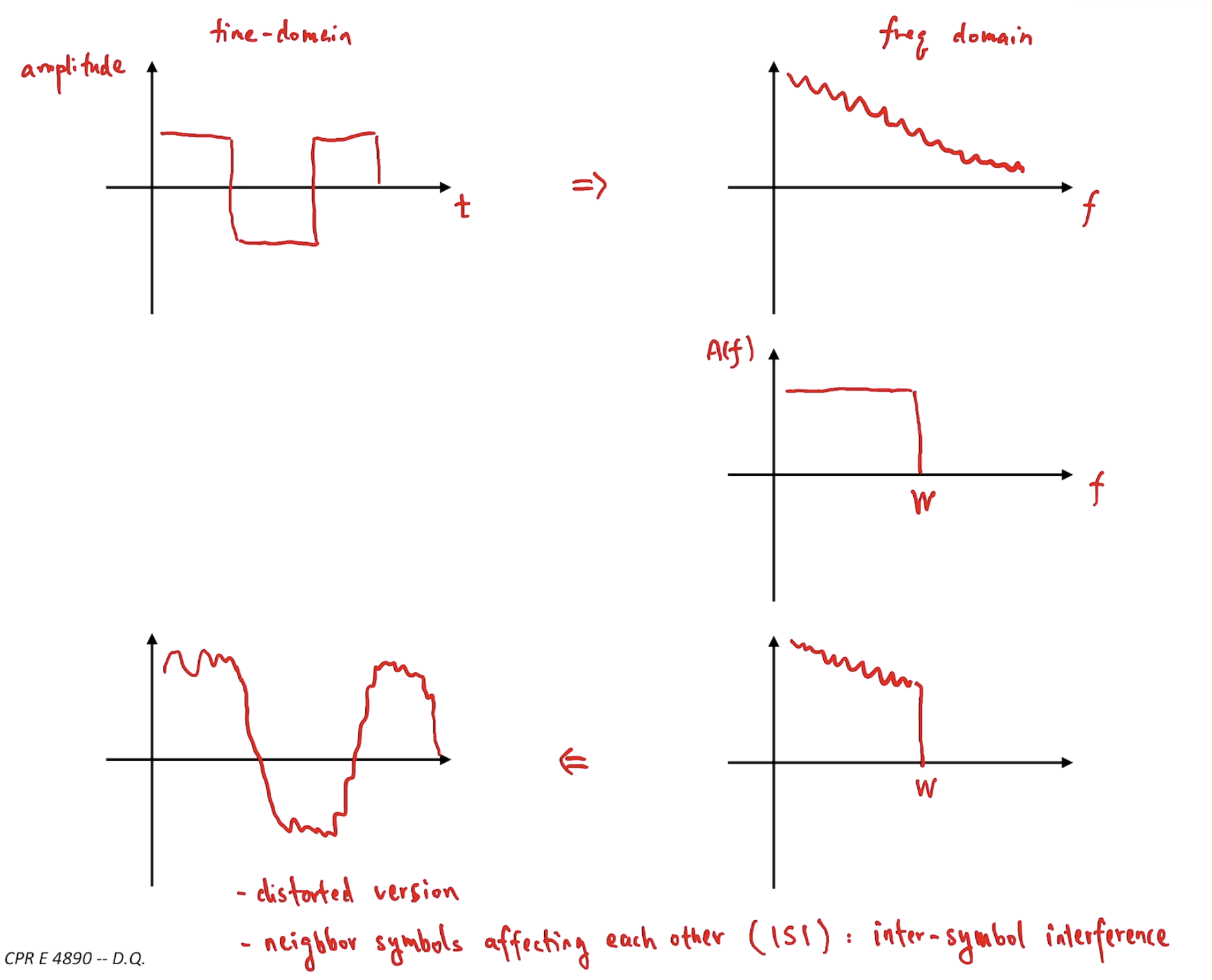
Transmission Channel and Channel Bandwidth
Channel Characterization
- Channels are characterized by their response to sinusoidal input signals at different frequencies.
Amplitude-Response Function
A(f) = Output signal amplitude / Input signal amplitude
Channel Bandwidth (W)
- Frequency range over which signals pass with acceptable attenuation.
Nyquist Rate
Definition
The Nyquist rate is the maximum theoretical baud rate for an ideal, noiseless channel.
Formula
r_max = 2W pulses/second
Where:
W= channel bandwidth (Hz)

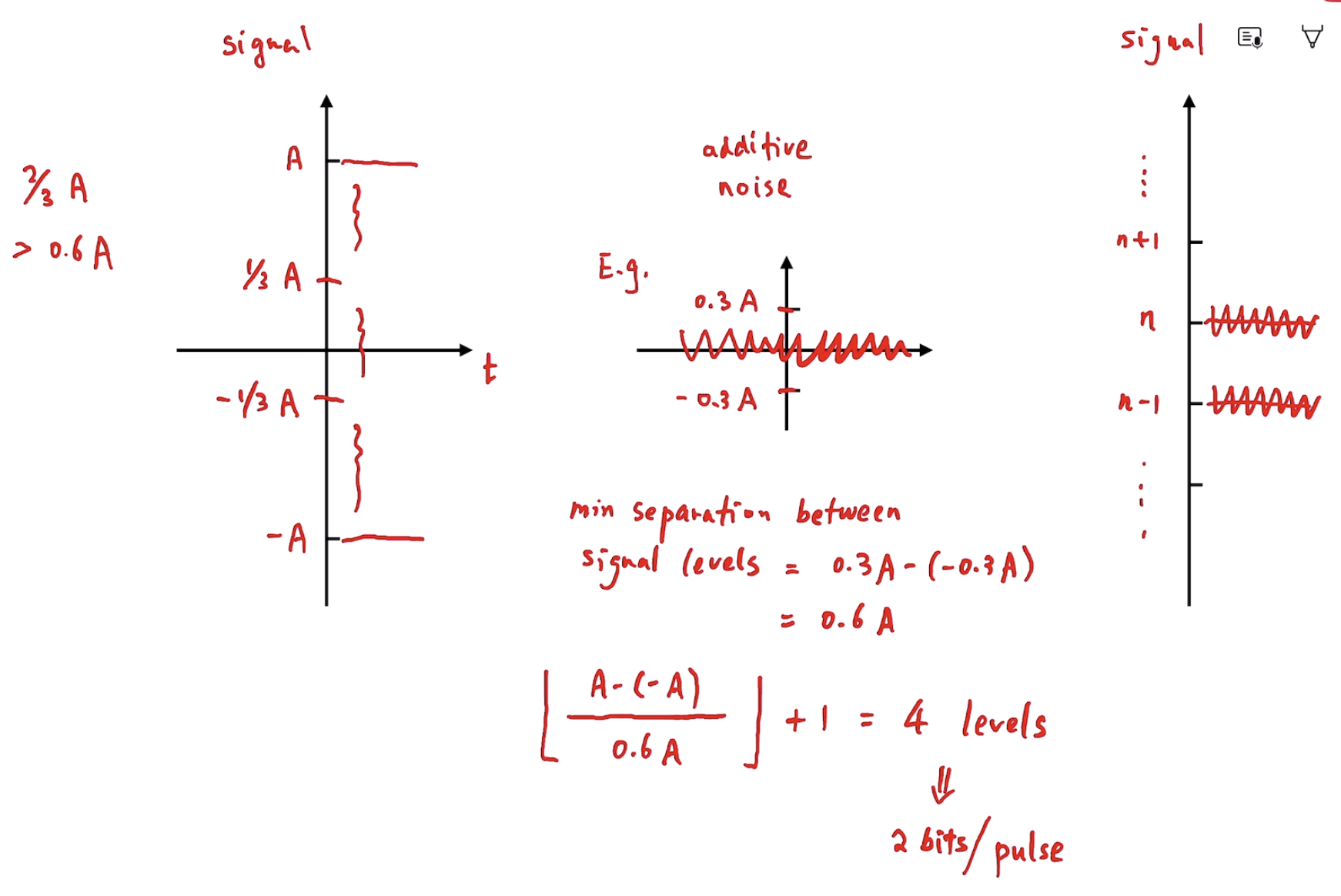
Noise and Reliable Communication
Impact of Noise
Noise:
- Limits accuracy of signal amplitude detection
- Restricts the number of usable signal levels
- Increases Bit Error Rate (BER)
Signal-to-Noise Ratio (SNR)
SNR = Average Signal Power / Average Noise Power
- Larger SNR → Lower BER
- Smaller SNR → Higher BER
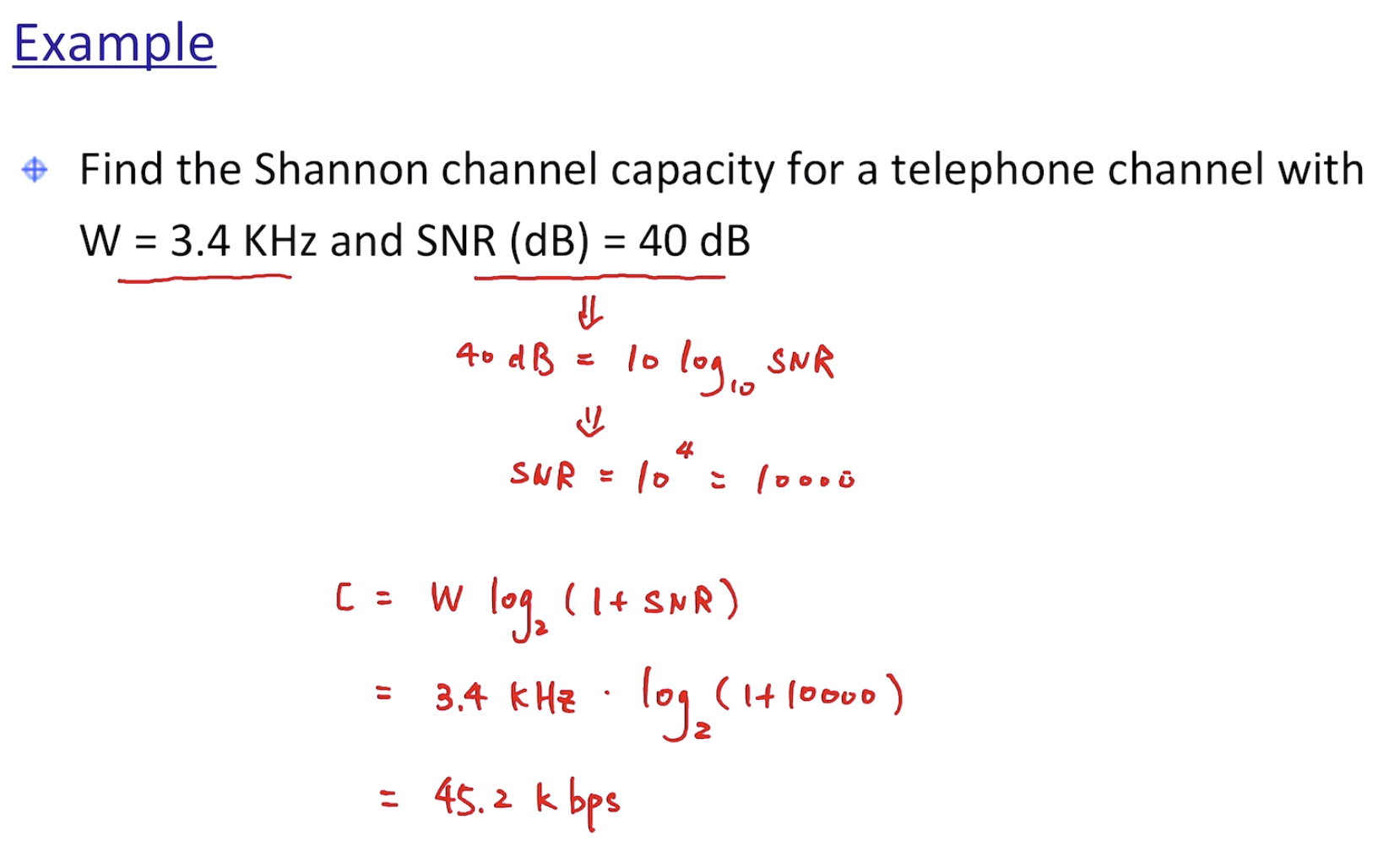
SNR in Decibels
SNR(dB) = 10 log₁₀(SNR)
Shannon Channel Capacity
Formula
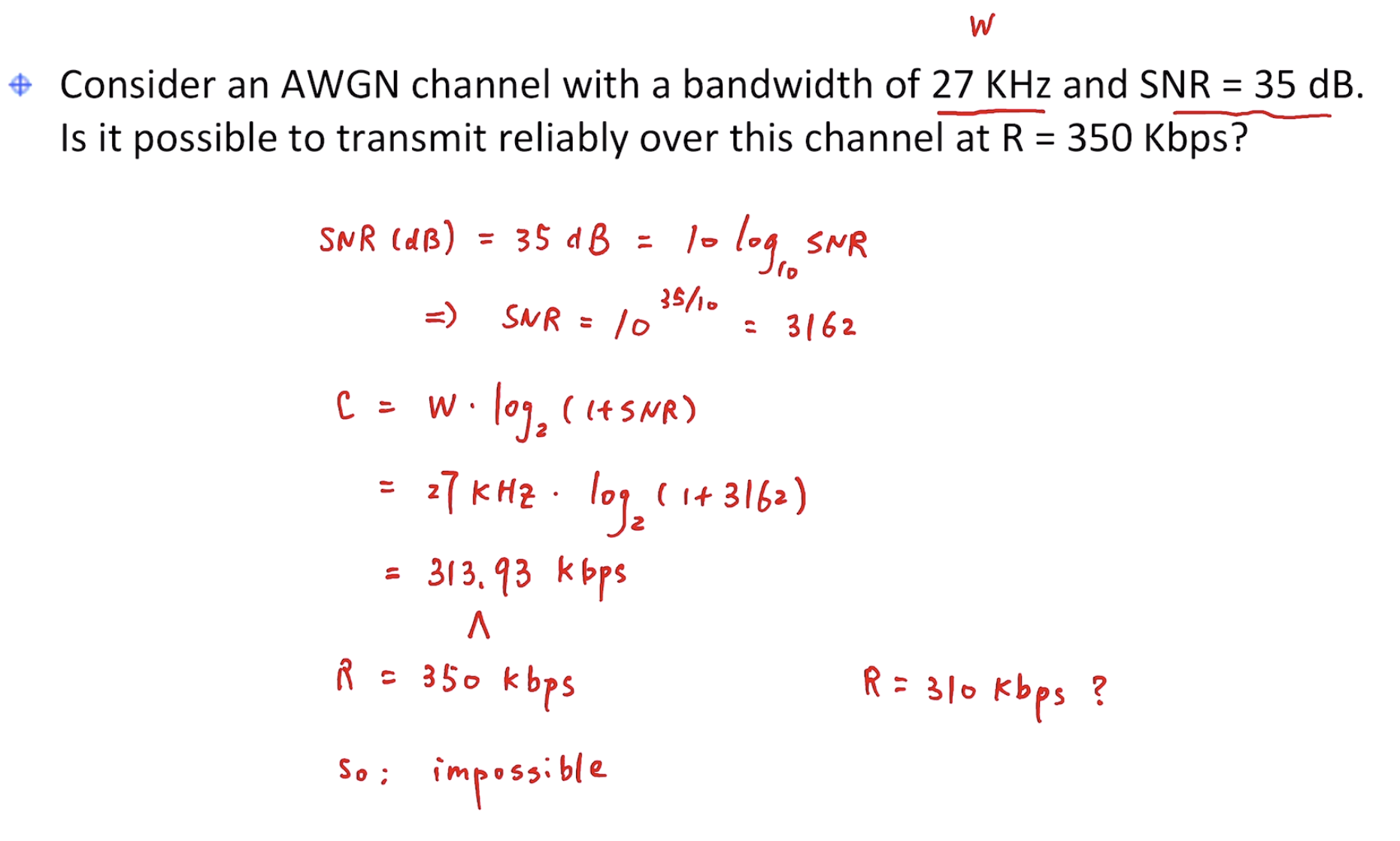
C = W log₂(1 + SNR) bps
Where:
C= channel capacityW= channel bandwidth (Hz)SNR= signal-to-noise ratio (linear)
Reliability Conditions
- If
R > C→ Reliable communication not possible - If
R ≤ C→ Arbitrarily reliable communication possible
Arbitrarily reliable means BER can be made arbitrarily small using sufficiently complex coding.
Line Coding Schemes
Design Considerations:
- Time Recovery
- Low Complexity & Implementation Cost
- Low Power & Energy Efficient
- Better immunity to noise & interference
- Built-in error detecting capability
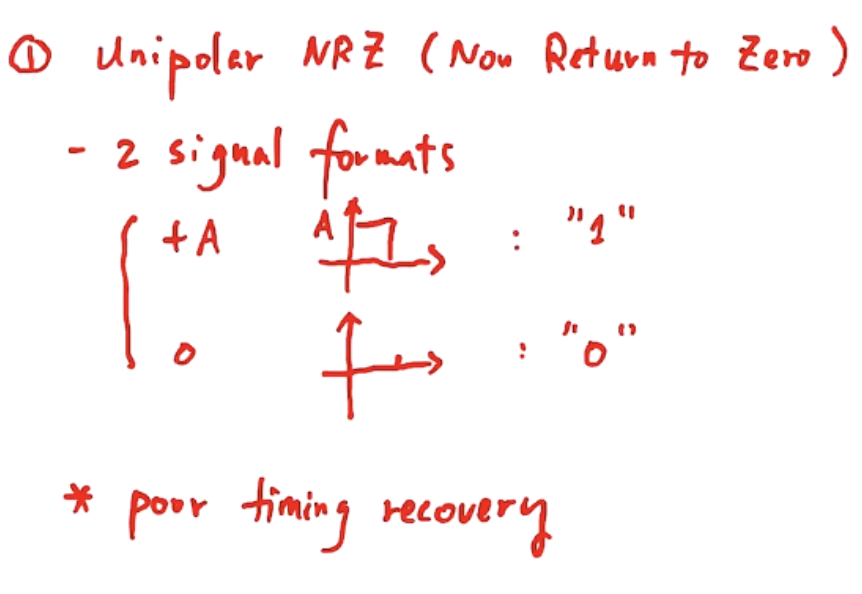
1. Unipolar NRZ
"1"→+A"0"→0- Drawback: Poor timing recovery, DC component
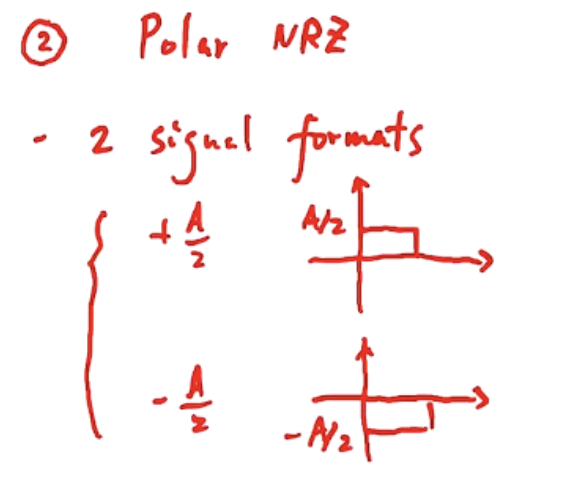
2. Polar NRZ
"1"→+A/2"0"→-A/2
Advantages
- Simple, energy efficient
- Better noise immunity
Drawback
- Poor timing recovery
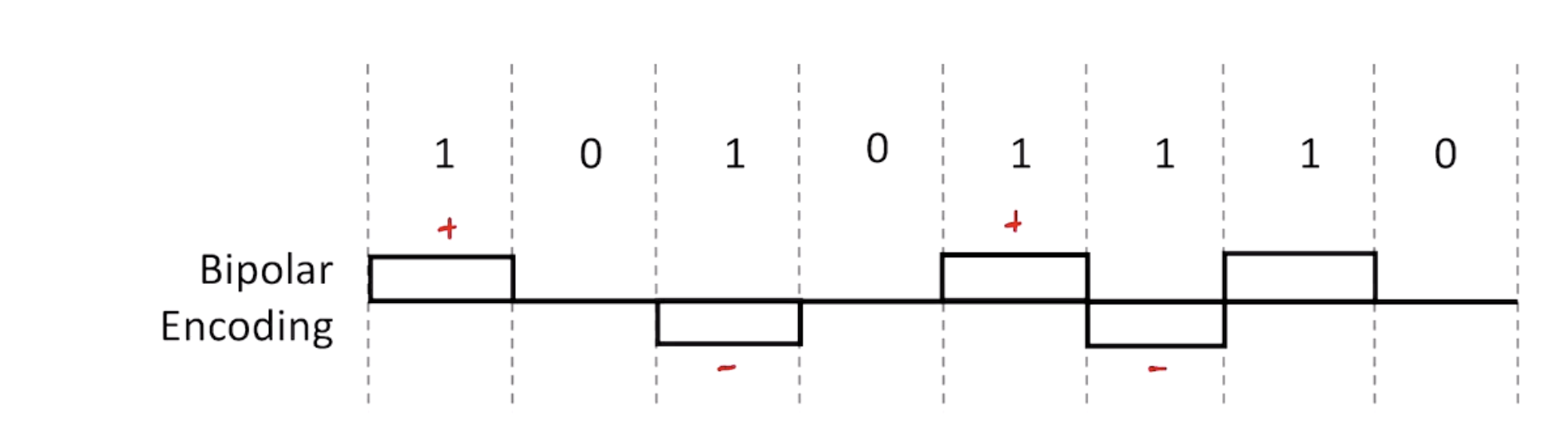
3. Bipolar Coding
"1"→ Alternates between+A/2and-A/2"0"→0
Features
- Zero DC component
- Zero substitution codes: B8ZS, B6ZS, B3ZS
Drawback
- Long runs of zeros cause synchronization loss
Bipolar Coding 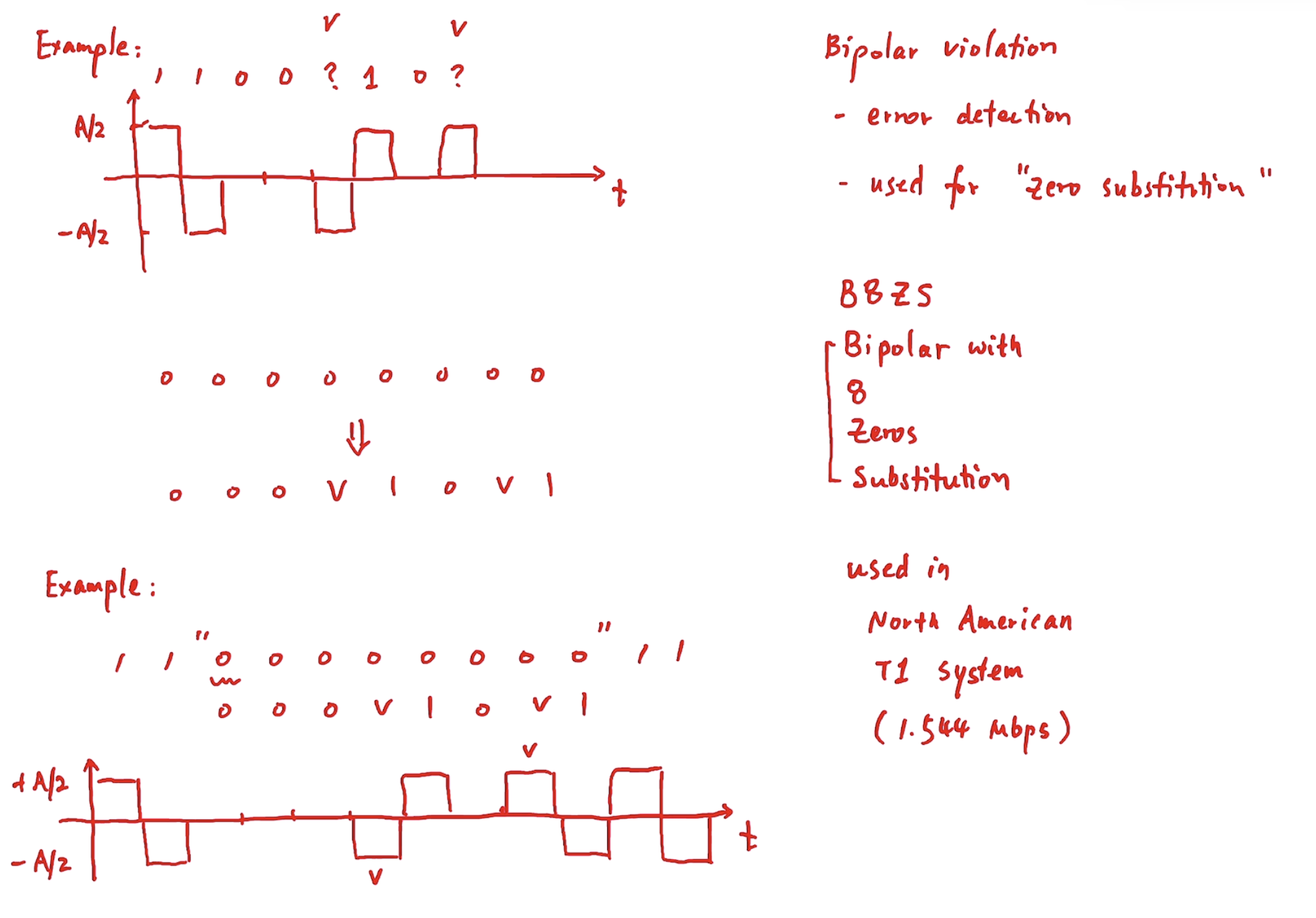
Bipolar Violation 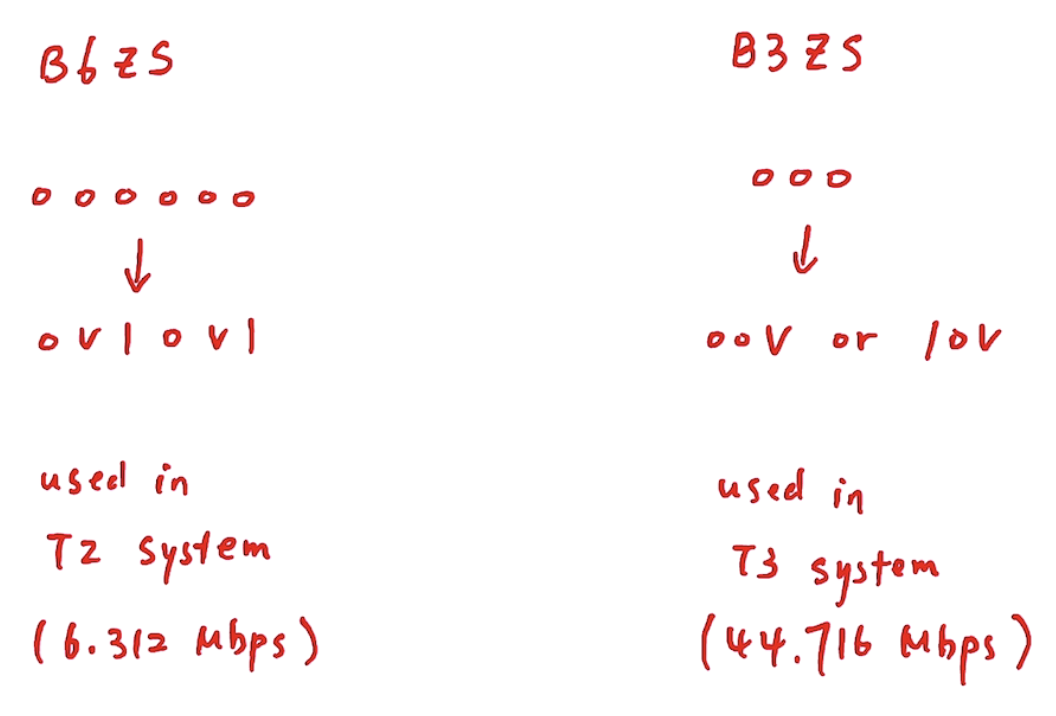
B6ZS & B3ZS
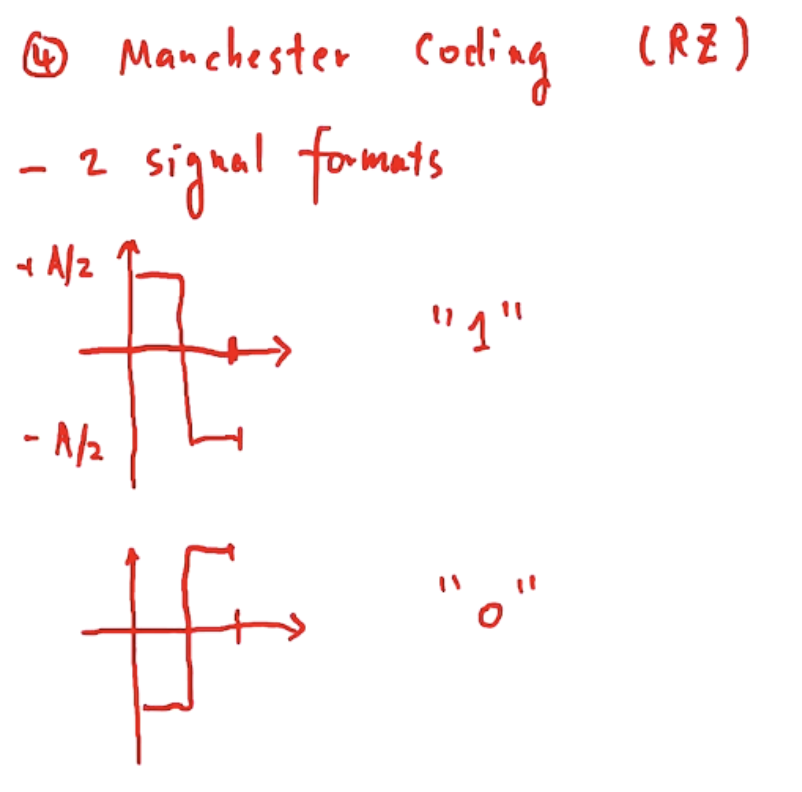
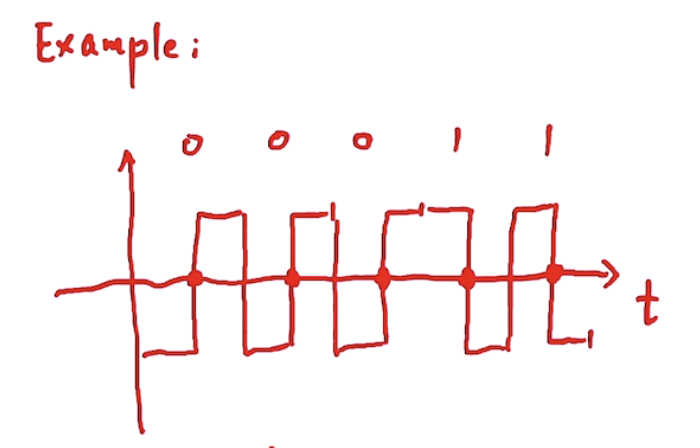
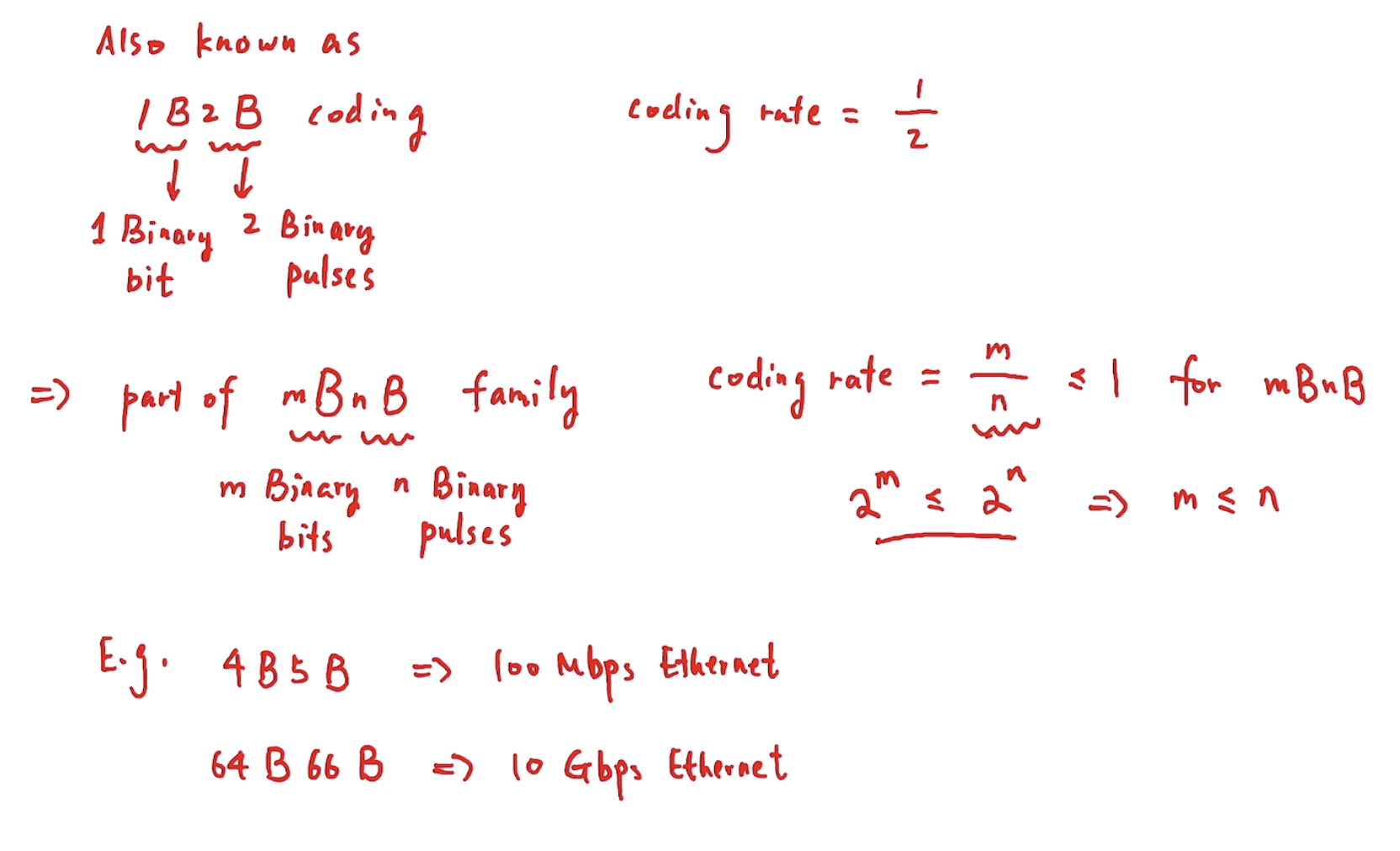
4. Manchester Coding (also known as 1B2B)
"1"→+A/2 → -A/2"0"→-A/2 → +A/2
Characteristics
- Self-clocking
- Excellent timing recovery
Coding Rate Coding rate = 1 bit / 2 pulses = 1/2 bit per pulse Bit rate = (1/2) × Baud rate
Example
10 Mbps → 20 MHz baud rate
5. mBnL Coding
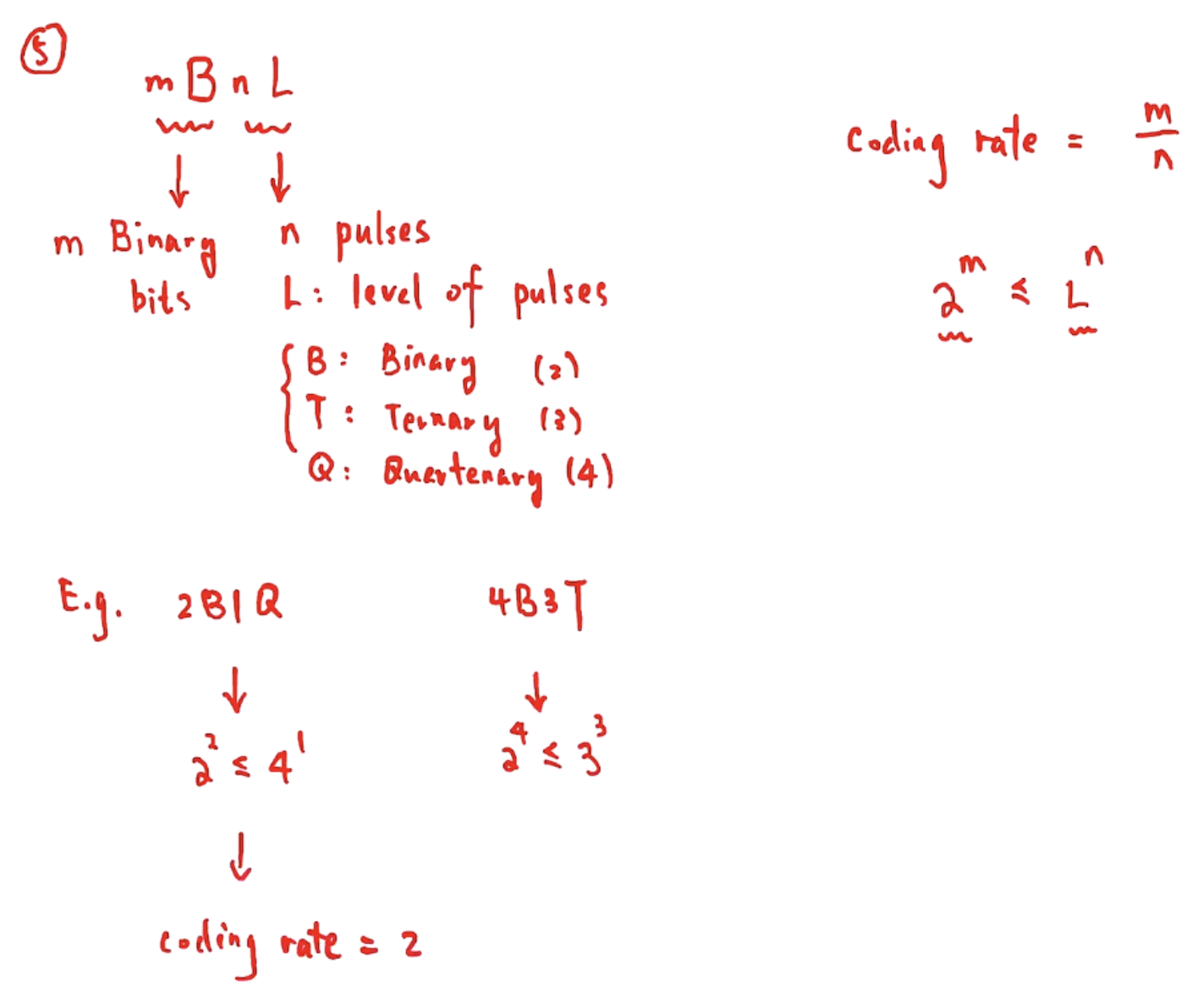
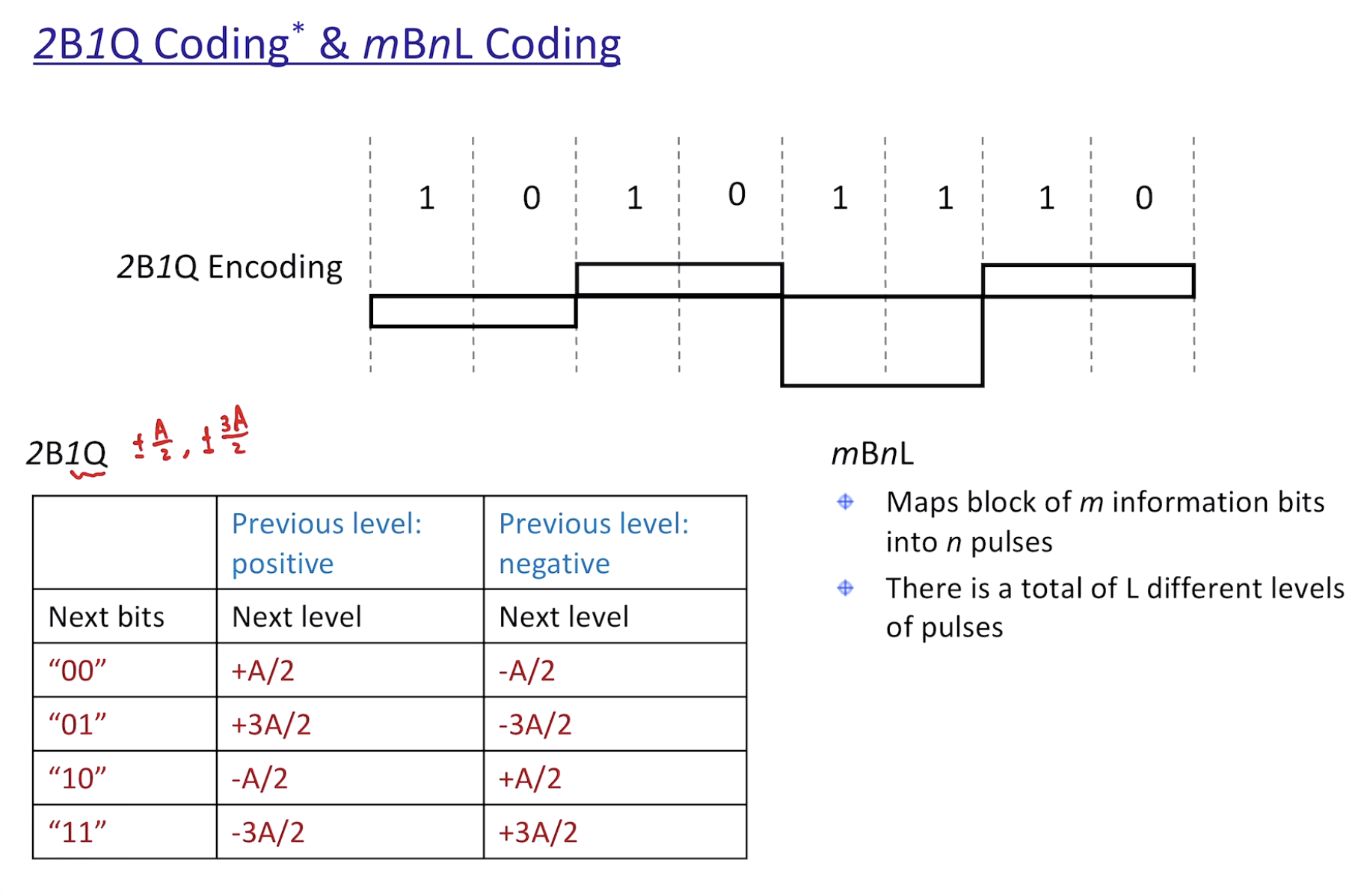
mbitsnpulsesLsignal levels
Constraint 2^m ≤ L^n
Coding Rate Coding rate = m / n
Examples
- 2B1Q → 2² ≤ 4¹
- 4B3T → 2⁴ ≤ 3³
6. NRZ Inverted (NRZI)
"1"→ Transition at bit start"0"→ No transition
Properties
- Differential encoding
- Polarity insensitive
- Errors occur in pairs
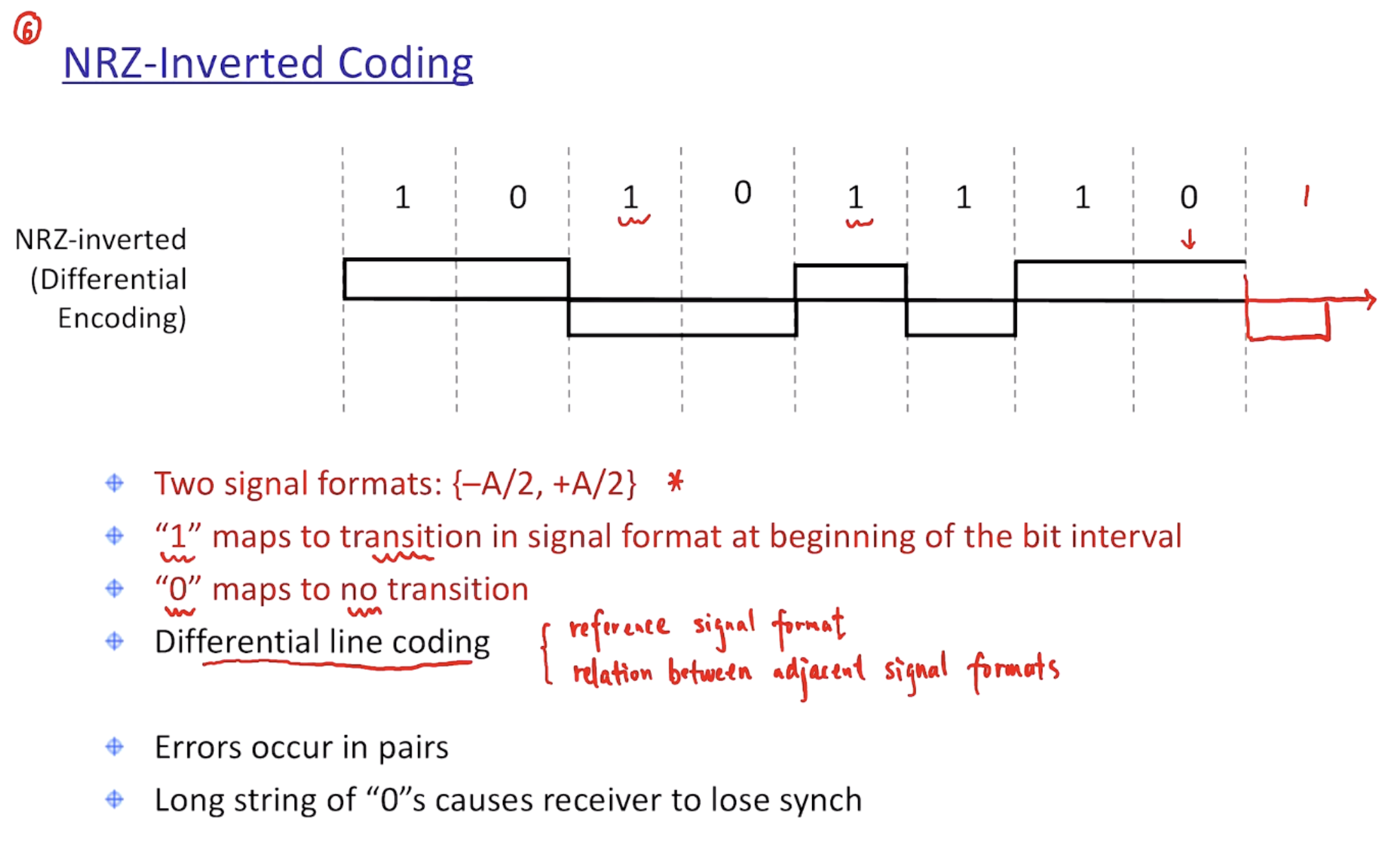
NRZ Inverted
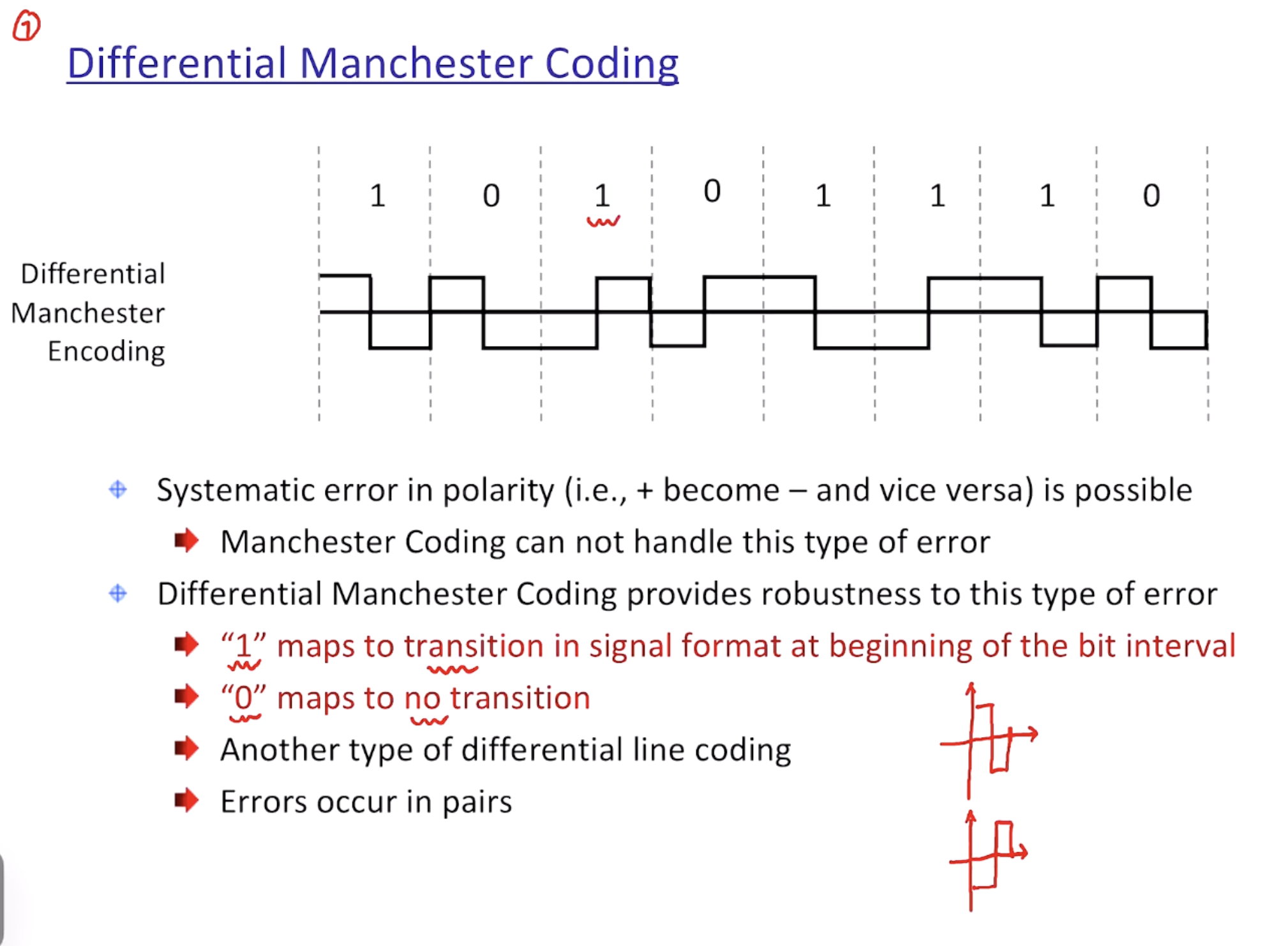
7. Differential Manchester Coding
"1"→ Transition at beginning"0"→ No transition at beginning- Mid-bit transition always occurs
Characteristics
- Polarity insensitive
- Excellent clock recovery
- Errors occur in pairs